


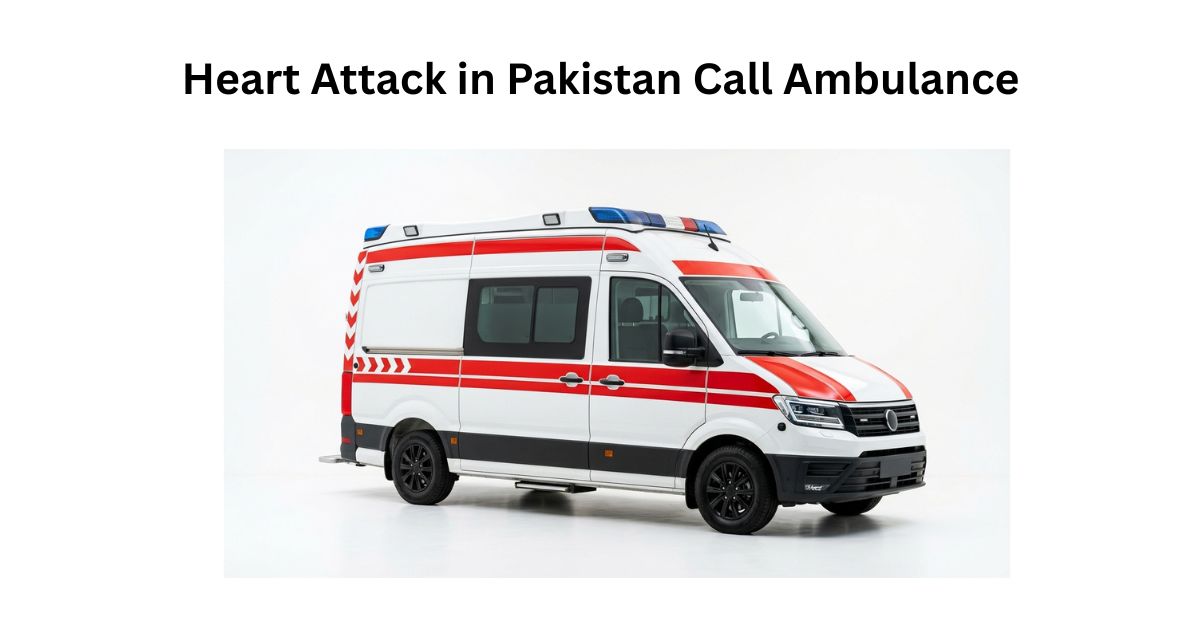
Heart Attack in Pakistan: Should You Call an Ambulance or Drive to Hospital?
📋 Table of Contents
- Recognise a Heart Attack Fast
- The Core Question: Ambulance vs Driving
- Why an Ambulance Is Almost Always Better
- When Families Choose to Drive
- Ambulance vs Driving – Full Comparison
- The Time Maths: What Ambulance Speeds vs Cars
- What Happens in a Cardiac Ambulance
- Choosing the Right Hospital
- What to Do While Waiting for the Ambulance
- Do's and Don'ts – Heart Attack
- Heart Attack Risk Factors in Pakistan
- FAQs – Heart Attack in Pakistan
- Related Articles & Services
Every year, hundreds of thousands of Pakistanis suffer heart attacks. Many die — not because treatment was unavailable, but because they reached it too late. The heart muscle doesn't wait. Once a coronary artery is blocked, the muscle it supplies begins to die within minutes, and the damage becomes permanent. The survival of a heart attack patient is decided, to a remarkable degree, by how fast they get medical care.
This creates a difficult decision that millions of Pakistani families make every year: do we call an ambulance, or do we put the patient in a car and drive to the hospital ourselves? In a country where traffic is chaotic, ambulance response times can be 20–35 minutes, and families often distrust emergency services, many people instinctively choose the car. It seems faster. It seems more under control.
This guide examines that decision honestly. It compares both options — timing, medical care, risks, and outcomes — and explains why, in almost every case, calling an ambulance saves more heart muscle, more time, and more lives. It also tells you exactly what to do while waiting, how to choose the right hospital, and the mistakes that turn a survivable heart attack into a fatal one.
❤️ Chest pain? Don't drive — call for a cardiac ambulance now.
📞 Call: +92 329 8041122 💬 WhatsApp Us🚨 Recognise a Heart Attack Fast
Before deciding what to do, you have to know what you're dealing with. Heart attacks don't always arrive with the classic "clutching the chest" image. Recognising the signs fast is the first step.
| Symptom | Description | How Common |
|---|---|---|
| Chest pain or pressure | Tightness, heaviness, squeezing in the centre of the chest | Most common |
| Radiating pain | Discomfort spreading to left arm, jaw, neck, or back | Very common |
| Shortness of breath | Difficulty breathing even at rest | Very common |
| Cold sweat | Sudden sweating without exertion | Common |
| Nausea or vomiting | Feeling sick to the stomach | Common |
| Dizziness or fainting | Lightheadedness, feeling faint | Moderate |
| Unusual fatigue | Sudden, unexplained tiredness (especially in women) | Common in women |
| Sense of doom | A strong feeling that something is seriously wrong | Common |
Women: Fatigue, breathlessness, jaw/back pain, nausea — sometimes without classic chest pain.
Elderly: Confusion, weakness, or fainting without significant chest pain.
Diabetics: Neuropathy can mask chest pain — the "silent heart attack."
South Asians: Heart attacks happen at younger ages than in Western populations. Never dismiss symptoms in a young person.
⭐ The Golden Rule
If you suspect a heart attack, the question is not "ambulance vs car" — it is "how do I get help fastest." In almost every case, the fastest way to get help is to call an ambulance. But never wait for one if the wait will be dangerously long — call, then decide.
🤔 The Core Question: Ambulance vs Driving
This is a genuinely difficult decision in Pakistan, and families make it in a state of panic. Both options have trade-offs. But the evidence is overwhelming — and the decision is more important than most people realise.
What families are actually weighing:
- ⏱️ Speed: Will the ambulance take longer than driving myself?
- 🚑 Medical care: Does the ambulance provide anything a car cannot?
- 🏥 Hospital choice: Which hospital will treat the patient best?
- 🛣️ Traffic: Will the ambulance get stuck in Rawalpindi/Lahore/Karachi traffic?
- 💰 Cost: Is the ambulance affordable?
- 📞 Uncertainty: Will the ambulance even come quickly?
All of these are legitimate concerns. But there is one factor that overrides them all: time to treatment, not time to hospital. A patient in a car reaches a hospital building. A patient in an ambulance reaches a treatment team. That difference determines survival.
✅ Why an Ambulance Is Almost Always Better
Here are the specific, concrete reasons why a cardiac-equipped ambulance beats a private car in almost every heart attack scenario.
| Advantage | Ambulance | Private Car |
|---|---|---|
| Cardiac monitoring en route | ✅ Continuous ECG monitors the heart rhythm throughout the journey | ❌ No monitoring at all |
| Defibrillator on board | ✅ Immediate shock if the patient goes into cardiac arrest | ❌ No defibrillator — a cardiac arrest in the car is fatal |
| Oxygen therapy | ✅ High-flow oxygen to protect the heart muscle | ❌ No oxygen |
| Aspirin and emergency drugs | ✅ Aspirin given immediately; nitroglycerin and morphine if indicated | ❌ Nothing given |
| IV access | ✅ Established for emergency medication if the patient deteriorates | ❌ No IV access |
| Hospital pre-notification | ✅ Cath lab team and ER prepared before arrival | ❌ Hospital has no warning; assessment starts on arrival |
| Correct hospital selection | ✅ Routed to a hospital with a cath lab and PCI capability | ❌ Family may unknowingly choose a hospital without cardiac intervention |
| Professional driving | ✅ Trained emergency drivers; route planning; traffic coordination | ❌ Panicked family driving; risk of a second accident |
| Family focus | ✅ Family can comfort the patient and prepare documents | ❌ Family must drive, navigate, and park while terrified |
| Onset time documentation | ✅ Precisely recorded for the hospital team | ❌ Often forgotten or unclear |
🫁 Administer high-flow oxygen
📈 Run a 12-lead ECG and identify the heart attack pattern
💊 Give aspirin (chewed) and nitroglycerin
💉 Establish IV access
💊 Give morphine for severe pain
⚡ Defibrillate if the patient goes into cardiac arrest
🫁 Perform CPR and advanced airway management if needed
📞 Pre-notify the cath lab and transmit the ECG
🏥 Route directly to a hospital with a working cath lab
🚗 When Families Choose to Drive
It's important to be honest about why families choose a car. There are legitimate reasons — and sometimes, in very specific circumstances, driving may genuinely be the right decision.
Legitimate Reasons Families Choose a Car
- ⏱️ The hospital is very close: If you live within 5 minutes of a hospital with a cath lab, the math could favour driving — but only if the patient is stable
- 🚑 Ambulance response is very slow: In remote areas, a private car may genuinely be the fastest option
- 💰 Cost concerns: Private ambulances charge PKR 8,000–40,000 for cardiac transports
- 🚗 Car and driver are ready: A family member is at the wheel, the car is outside, and there is no delay
- 🤷 Distrust of emergency services: Some families have had bad experiences and prefer to keep control
- 🏥 Family knows the hospital and route: In a familiar area, a family driver may navigate more confidently
When Driving Might Be the Right Choice
- ✅ Patient is stable and conscious
- ✅ Hospital is genuinely closer than any available ambulance
- ✅ There is no cardiac-capable ambulance in your area
- ✅ Roads are clear and the drive is short
- ✅ You have a second adult in the car who can monitor the patient
The safest approach in almost every scenario is: Call the ambulance first. If it will take longer than driving, and the patient is stable, you can decide to drive while the ambulance is on the way.
📊 Ambulance vs Driving – Full Comparison
Here is a full comparison of the two options across every factor that matters.
| Factor | Ambulance | Private Car |
|---|---|---|
| Time to a hospital | Usually 20–35 minutes in cities | 10–30 minutes |
| Time to a treatment team | Usually 25–40 minutes (includes pre-notification) | 25–50 minutes (hospital team assembles after arrival) |
| Medical care en route | ✅ Full cardiac care | ❌ None |
| ECG diagnosis | ✅ 12-lead ECG done in the ambulance | ❌ Done after arrival |
| Aspirin given | ✅ Given within minutes | ❌ Given only after arrival |
| Cardiac arrest survival | ✅ Defibrillator ready, CPR trained | ❌ Very low — no equipment |
| Hospital routing | ✅ Routed to a cath lab capable facility | ❌ Family may choose the wrong hospital |
| Pre-notification | ✅ Cath lab ready before arrival | ❌ No warning |
| Cost | PKR 8,000–40,000 | Fuel only |
| Risk of second accident | Low — professional drivers | Higher — panicked driving |
| Family control | Lower | Higher |
| Overall recommendation | 🟢 Strongly preferred | 🟡 Only in specific circumstances |
📊 Estimated Time to Treatment – Ambulance vs Car
*Illustrative comparison. Even when a car covers the distance faster, the ambulance reaches "treatment" sooner because of pre-notification and pre-hospital care.
⏱️ The Time Maths: What Ambulance Speeds vs Cars
The instinctive comparison — "the car leaves now, the ambulance takes 25 minutes to arrive" — misses something crucial. The relevant metric is not when the car leaves. It is when the treatment begins.
The Two Time Math Paths
| Stage | Ambulance Path | Car Path |
|---|---|---|
| Call made | 0 min | 0 min (skipped call) |
| Time until help begins | 20–30 min (ambulance arrives) | 0 min (but no medical help) |
| Aspirin / oxygen | At 20–30 min | At 40–55 min (after hospital intake) |
| ECG diagnosis | At 25–35 min (in ambulance) | At 45–60 min (at hospital) |
| Defibrillation if cardiac arrest | Immediate — defibrillator on board | None — likely fatal |
| Cath lab prepared | Yes — pre-notified | No — assembling after arrival |
| Time from call to treatment | ~30–40 min | ~45–60 min |
⭐ The Key Insight
A car may reach the hospital building faster than an ambulance arrives at your door. But an ambulance reaches treatment faster than a car — because treatment begins during the journey, and the hospital is prepared before arrival.
For a heart attack, the metric that saves lives is time to reperfusion (restoring blood flow) — not time to the parking lot.
🩺 What Happens in a Cardiac Ambulance
Understanding exactly what the ambulance team does can reassure families and settle the decision. Here is what happens in a cardiac-equipped ambulance on the way to the hospital.
Step 2 – 12-lead ECG: Performed within minutes of arrival — identifies ST-elevation MI.
Step 3 – Oxygen therapy: Applied if SpO₂ is below 94%.
Step 4 – Aspirin: 300 mg chewed (if not allergic, not bleeding).
Step 5 – Nitroglycerin: Given for ongoing chest pain (if blood pressure allows).
Step 6 – IV access: Established for emergency drugs.
Step 7 – Pain relief: Morphine if pain is severe.
Step 8 – Continuous cardiac monitoring: Detects arrhythmias before they become fatal.
Step 9 – Hospital pre-notification: Cath lab team alerted; ECG findings transmitted.
Step 10 – Defibrillator ready: Immediate shock if cardiac arrest occurs.
Step 11 – Continuous reassessment: Paramedic monitors the patient every few minutes.
Step 12 – Handover: Structured briefing to the receiving team; patient moved directly to cath lab or CCU.
This is why an ambulance matters. Even if the drive is 10 minutes faster than the ambulance response, the patient receives medical care 30–40 minutes earlier through the ambulance route — because nothing is done for the patient in the car except driving.
🏥 Choosing the Right Hospital
For a heart attack, the hospital matters almost as much as the ambulance. You need a facility with a cardiac catheterisation lab (cath lab) and 24/7 primary PCI (angioplasty) capability.
What a Heart Attack Needs From a Hospital
- 🩻 24/7 cardiac catheterisation lab
- 👨⚕️ On-call interventional cardiologist
- 📈 12-lead ECG and troponin testing
- 🫀 Primary PCI capability — angioplasty within 90 minutes of arrival
- 🏥 Cardiac ICU for post-procedure care
- 💉 Thrombolysis backup if PCI is not immediately available
- 🫁 Ventilator support for complications
Cardiac-Capable Hospitals in Major Cities
| City | Hospitals with Cath Lab / Cardiac Care |
|---|---|
| Rawalpindi / Islamabad | AFIC, CMH Rawalpindi, Shifa International, PIMS, Quaid-e-Azam International |
| Lahore | Punjab Institute of Cardiology (PIC), Jinnah Hospital, Mayo, Shifa, Doctors Hospital |
| Karachi | NICVD, Aga Khan University Hospital, Liaquat National, Tabba Heart, Ziauddin |
| Peshawar | Peshawar Institute of Cardiology (PIC), Lady Reading Hospital, Rehman Medical Institute |
| Multan | Chaudhry Pervaiz Elahi Institute of Cardiology (CPEIC), Nishtar Hospital |
| Faisalabad | Faisalabad Institute of Cardiology (FIC), Allied Hospital |
✅ What to Do While Waiting for the Ambulance
Once the call is made, your job is to keep the patient calm and comfortable, and prepare for arrival. Here is exactly what to do.
2. Absolute rest: Do not let them walk, climb stairs, or exert themselves.
3. Loosen tight clothing: Collar, tie, scarf, belt.
4. Give aspirin (if appropriate): 300 mg chewed, if conscious, not allergic, not actively bleeding, not already on aspirin.
5. Do NOT give food or water: The patient may need emergency surgery or a procedure.
6. Keep them warm: A light blanket helps prevent shock.
7. Reassure them continuously: Anxiety increases cardiac workload.
8. Note the exact onset time: The single most important piece of information you'll give the paramedics.
9. Note their medications: Especially blood thinners, BP meds, and diabetes medication.
10. Gather documents: CNIC, medical reports, medication list, hospital cards.
11. Send a WhatsApp location pin: So the driver can find you exactly.
12. Send someone to guide the ambulance to your building.
13. Clear a path for the stretcher: Open doors, move furniture.
14. If they become unresponsive and stop breathing normally: start CPR immediately.
For a complete guide to the waiting phase, see our article on what to do while waiting for the ambulance.
✅❌ Do's and Don'ts – Heart Attack
✅ DO These
- Call an ambulance first
- Keep the patient seated and calm
- Give aspirin (if appropriate)
- Loosen tight clothing
- Note the onset time
- Reassure the patient constantly
- Send a WhatsApp location pin
- Send someone to guide the ambulance
- Gather documents and medications
- Monitor breathing
- Start CPR if the patient becomes unresponsive
- Choose a hospital with a cath lab
❌ DON'T Do These
- Do not let the patient drive themselves
- Do not let them walk or climb stairs
- Do not give food or water
- Do not give nitroglycerin unless prescribed
- Do not give aspirin if they are bleeding or allergic
- Do not "wait to see if it passes"
- Do not take them to a hospital without a cath lab
- Do not give home remedies or desi ilaj
- Do not let them sleep it off
- Do not crowd them
- Do not delay calling the ambulance
- Do not assume "it's just acidity"
⚠️ Heart Attack Risk Factors in Pakistan
Pakistan has among the highest rates of cardiovascular disease in the world, and heart attacks are occurring at younger ages than in Western populations. Knowing the risk factors helps families act early.
| Risk Factor | Why It Matters | Prevention |
|---|---|---|
| High blood pressure | Damages coronary arteries over years | Regular BP checks; medication adherence; low salt |
| Diabetes | Accelerates plaque build-up; can mask symptoms | Blood sugar control; diet; medication |
| Smoking | Increases clot risk; narrows arteries | Quit smoking entirely |
| High cholesterol | Builds plaque in coronary arteries | Diet; statins if prescribed |
| Obesity and physical inactivity | Increases cardiac workload | 30 min of activity daily; weight management |
| Family history | Genetic predisposition | Screen early; lifestyle modification |
| Stress and poor sleep | Raises BP and cardiac risk | Sleep hygiene; stress management |
| Diet high in fried food and ghee | Common in Pakistani households | Reduce fried and processed foods |
| South Asian ethnicity | Earlier onset heart disease | Screen earlier; regular checkups from age 30–35 |
| Previous heart attack or angina | Highest risk group for recurrence | Strict secondary prevention with medication |
⭐ Quick Final Summary
Call an ambulance if: You suspect a heart attack. Almost always. This is the standard of care worldwide.
Drive only if: You live within a very short distance of a cath-lab hospital, the patient is stable, no cardiac ambulance is available, and you have a second adult who can monitor the patient and call the hospital in advance.
Never: Let the patient drive themselves. Never delay calling to "see if it passes." Never take a heart attack patient to a hospital without a cath lab.
❓ Frequently Asked Questions – Heart Attack in Pakistan
1. Should I call an ambulance or drive to the hospital during a heart attack?
Call an ambulance. In almost every case, a cardiac-equipped ambulance is the safer option. It brings a monitor, defibrillator, oxygen, aspirin, and trained paramedics to the patient — and pre-notifies the cath lab so the patient is treated immediately on arrival. Even when a car might reach the hospital building faster, the ambulance reaches treatment faster because the patient receives medical care en route. Call +92 329 8041122 immediately.
2. What if the ambulance takes 30 minutes to arrive?
Call the ambulance and stay on the line. The dispatcher can guide you through first aid while the ambulance is en route. If the ambulance genuinely cannot arrive within a reasonable time, and the patient is stable, you may decide to drive while the ambulance is on the way. But the safest approach is to call first — because the ambulance will be pre-notified, will reach you or meet you en route, and will hand over to a prepared hospital team.
3. Why is a hospital with a cath lab important for a heart attack?
A heart attack is caused by a blocked coronary artery. The definitive treatment is to reopen that artery — usually through primary PCI (angioplasty) in a cardiac catheterisation lab. Only hospitals with a cath lab and 24/7 interventional cardiology can perform this. Taking a patient to a hospital without a cath lab wastes crucial time and may require a second transfer. When calling the ambulance, say clearly: "I suspect a heart attack — please take us to a hospital with a cardiac cath lab."
4. Should I give aspirin while waiting for the ambulance?
Yes, if the patient is conscious, not allergic to aspirin, not actively bleeding, and not already on aspirin or blood thinners. Give 300 mg of regular aspirin to chew (not swallow whole) — chewing speeds absorption. Aspirin reduces clot progression and improves survival. If in doubt, ask the dispatcher — they can guide you. Do NOT give aspirin if the patient has a bleeding disorder or is vomiting blood.
5. Can I give the patient water or food during a heart attack?
No. Do not give food or water to a patient having a heart attack. They may need emergency angiography, angioplasty, or surgery — all of which require an empty stomach. Choking risk is also significant if they become unresponsive or nauseated. Keep them comfortable, seated, and calm. Only medication (aspirin if appropriate) should be given, and nothing else.
🔗 Related Articles & Our Ambulance Services
Our Services:
🚑 Ambulance Service in Pakistan✈️ Airport Ambulance Service
🎪 Event Medical Coverage Pakistan
🏥 ICU Ambulance Service
Helpful Articles:
⏱️ What to Do While Waiting for the Ambulance: Pakistan Emergency Guide🧠 Stroke Emergency in Pakistan: Every Second Counts — Call Ambulance First
🚗 Road Accident in Rawalpindi: What to Do & How to Call Emergency Ambulance
🚨 Emergency Ambulance in Faisalabad: Private vs Government Services
❤️ Chest pain is not a wait-and-see emergency. Call now.
📞 Call: +92 329 8041122 💬 WhatsApp UsCardiac-equipped ALS and ICU ambulances with oxygen, monitor, defibrillator, and trained paramedics — 24/7 across Pakistan.
© Insaf Ambulance Services – Rapid, Reliable, and Compassionate Emergency Care Across Pakistan.