


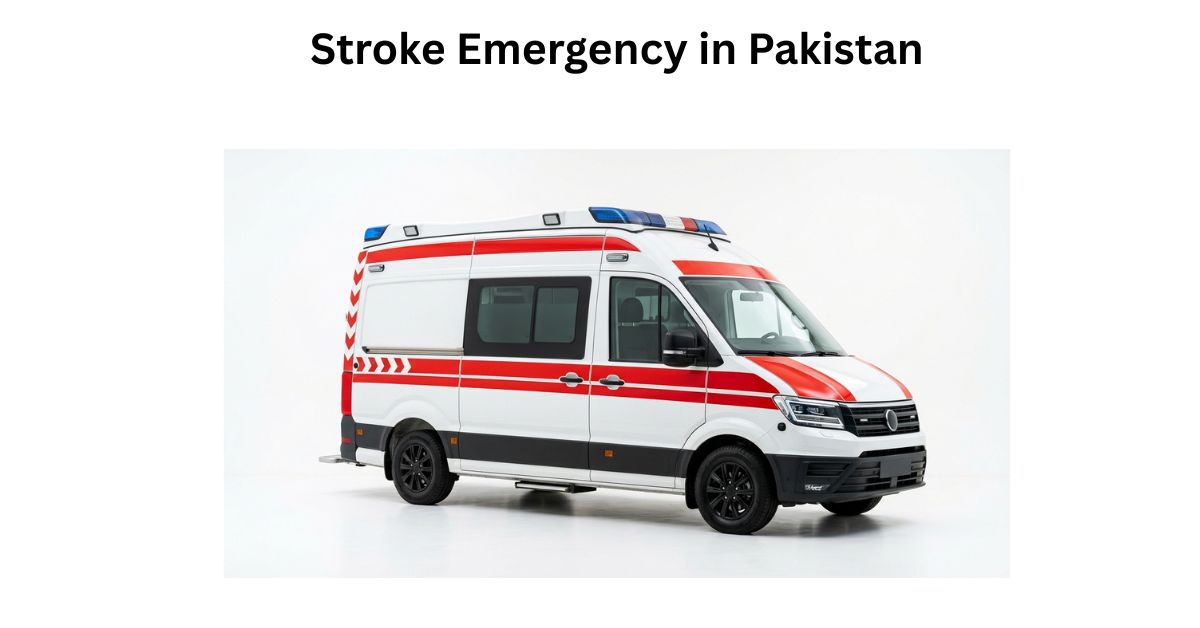
Stroke Emergency in Pakistan: Every Second Counts — Call Ambulance First
📋 Table of Contents
- Why Stroke Is a Race Against the Clock
- The FAST Test – Recognise Stroke in 30 Seconds
- Why You Must Call an Ambulance First
- What Happens to the Brain Minute by Minute
- Treatment Time Windows in Pakistan
- Types of Stroke & Why Treatment Differs
- What to Do While Waiting for the Ambulance
- What NOT to Do – Critical Mistakes
- Stroke Risk Factors in Pakistan
- What Paramedics Do En Route
- Stroke-Ready Hospitals & Pre-Notification
- Preventing Stroke in Your Family
- FAQs – Stroke Emergency in Pakistan
- Related Articles & Services
A stroke is not a slow illness. It is a sudden, violent event inside the brain — a blocked artery or a burst vessel that cuts off oxygen to millions of neurons at once. From the instant it begins, brain tissue is dying. And unlike many medical conditions, the outcome is decided almost entirely by how quickly you act.
In Pakistan, stroke is among the top causes of death and the single largest cause of long-term disability. Yet awareness remains dangerously low. Families dismiss one-sided weakness as "gas," slurred speech as tiredness, or a drooping face as a minor problem. Many wait hours before seeking help — by which time the treatment window has closed and the damage is permanent. Others make a second fatal mistake: they drive the patient themselves instead of calling an ambulance.
This guide is written for every Pakistani household. It explains the FAST signs, why calling an ambulance first is the single most important decision you will make, how narrow the treatment windows really are, what to do while help is on the way, and the mistakes that turn a survivable stroke into a lifelong disability. Read it now, share it with your family, and save the number.
🧠 Why Stroke Is a Race Against the Clock
Stroke is often called a "brain attack" for good reason. Just as a heart attack kills heart muscle, a stroke kills brain tissue — and brain tissue does not regenerate. Every function controlled by the affected area — speech, movement, memory, swallowing, vision — can be lost permanently.
- 🧠 Approximately 1.9 million neurons are lost per minute during an untreated stroke
- ⏱️ 14 billion synapses are destroyed each minute
- 📉 7.5 kilometres of myelinated nerve fibres are lost per minute
- ♿ Permanent disability is far more common than death — leaving families to provide lifelong care
- 💔 Recurrent stroke risk is high in the first weeks after a first event
- 💰 Financial devastation — rehabilitation, lost income, and caregiving costs compound for years
📉 Approximate Brain Cells Lost Over Time (Untreated Stroke)
*Approximate figures based on published stroke research. The message is simple: time is brain.
⭐ The Single Most Important Sentence in This Article
If you see even ONE sign of stroke, call an ambulance immediately. Do not wait to see if it passes. Do not give home remedies. Do not drive the patient yourself. Note the time symptoms began and call +92 329 8041122.
⚡ The FAST Test – Recognise Stroke in 30 Seconds
FAST is the internationally recommended tool for spotting stroke. Every Pakistani family should know it by heart.
🚨 The FAST Test
F – Face: Ask the person to smile. Does one side of the face droop?
A – Arms: Ask them to raise both arms. Does one arm drift downward or fail to rise?
S – Speech: Ask them to repeat a simple sentence. Is speech slurred, strange, or absent?
T – Time: If ANY of these signs is present, call an ambulance IMMEDIATELY and note the exact time symptoms started.
Additional Stroke Signs Beyond FAST
| Symptom | What It May Indicate | Action |
|---|---|---|
| Sudden vision loss or double vision | Blockage affecting the eye or visual cortex | 🔴 Call ambulance |
| Sudden loss of balance or coordination | Cerebellar or brainstem stroke | 🔴 Call ambulance |
| Sudden severe "thunderclap" headache | Possible hemorrhagic stroke | 🔴 Call ambulance |
| Numbness on one side of the body | Cortical stroke | 🔴 Call ambulance |
| Confusion or trouble understanding speech | Left hemisphere involvement | 🔴 Call ambulance |
| Difficulty swallowing or drooling | Brainstem or cranial nerve involvement | 🔴 Call ambulance |
| Sudden severe dizziness with vomiting | Posterior circulation stroke | 🔴 Call ambulance |
📞 Why You Must Call an Ambulance First
Many Pakistani families make a well-intentioned but dangerous decision: they rush the patient to hospital in their own car. For stroke, this is the wrong choice — and here is exactly why.
| Reason | Ambulance Advantage | Self-Transport Disadvantage |
|---|---|---|
| Hospital pre-notification | Receiving hospital is alerted and the stroke team prepared before arrival | Hospital has no warning — assessment starts only after you arrive |
| Right hospital selection | Dispatchers route to a stroke-ready facility with CT and thrombolysis capability | Family may unknowingly choose a hospital without CT or stroke care |
| Onboard treatment | Oxygen, monitoring, IV access, and airway protection en route | No medical care during the journey |
| Deterioration management | Paramedics recognise and treat seizures, aspiration, or cardiac arrhythmias | No one able to intervene if the patient deteriorates |
| Emergency driving and priority | Trained emergency drivers, hazard warning, and coordination with traffic police | Panicked family driving unsafely, risking a second accident |
| Time documentation | Precise onset time recorded and communicated — critical for treatment eligibility | Onset time often unclear or forgotten in the rush |
| Family focus | Family can comfort the patient and manage documents | Family must navigate traffic, parking, and hospital reception |
🚑 Why the Ambulance Saves Minutes
A stroke patient arriving by ambulance in Pakistan can be assessed, scanned, and treated significantly faster than one arriving by private car — because the hospital is already expecting them, the stroke team is assembled, and the CT scanner is cleared. Those saved minutes are brain tissue.
⏱️ What Happens to the Brain Minute by Minute
Understanding the speed of stroke damage is the most powerful motivator to act immediately.
📊 Outcome Probability vs Time to Treatment (Ischaemic Stroke)
*Illustrative of typical thrombolysis eligibility. Selected patients may qualify for mechanical thrombectomy up to 24 hours.
What Stroke Costs Families in Pakistan
- 🏥 Weeks in hospital for acute care and complication management
- 🦽 Months of rehabilitation — physiotherapy, speech therapy, occupational therapy
- 👨👩👧 Permanent caregiving — often a family member forced to stop working
- 💸 Ongoing medication — blood thinners, blood pressure control, statins
- 😔 Loss of independence — for previously healthy, working adults this is devastating
- 📉 Financial ruin — medical bills combined with lost household income
The difference between reaching hospital in 45 minutes and reaching it in 4 hours can be the difference between returning to work and never walking again. This is why "call ambulance first" is not a slogan — it is a medical instruction.
🕐 Treatment Time Windows in Pakistan
Stroke treatment is defined by time windows. Knowing them helps families understand why urgency matters and why the ambulance's pre-notification is so valuable.
| Treatment | Time Window | What It Does | Availability in Pakistan |
|---|---|---|---|
| IV Thrombolysis (clot-busting drug) | Up to 3–4.5 hours from onset | Dissolves the clot and restores blood flow | Available at major tertiary hospitals |
| Mechanical Thrombectomy | Up to 6–24 hours (selected patients) | Physically removes the clot via catheter | Limited centres — major cities only |
| CT scan for diagnosis | Immediately on arrival | Distinguishes ischaemic from haemorrhagic stroke | Widely available in tertiary hospitals |
| Antithrombotic therapy | After 24–48 hours (ischaemic) | Prevents recurrence | Widely available |
| Neurosurgery | Urgent for haemorrhage | Relieves pressure from bleeding | Limited to major centres |
🔬 Types of Stroke & Why Treatment Differs
Not all strokes are treated the same way — and giving the wrong first aid can be harmful. This is another reason why professional assessment matters.
| Type | Cause | Percentage | Treatment | Danger of Aspirin? |
|---|---|---|---|---|
| Ischaemic Stroke | A clot blocks an artery in the brain | ~85% | Clot-busting drugs, thrombectomy | Generally helpful, but only after CT confirmation |
| Haemorrhagic Stroke | A blood vessel in the brain bursts | ~15% | Blood pressure control, neurosurgery | 🔴 Dangerous — worsens bleeding |
| Transient Ischaemic Attack (TIA) | Temporary clot; symptoms resolve | Warning sign | Urgent evaluation and prevention | Prescribed after assessment |
This is why you must not give aspirin. Because families cannot tell an ischaemic stroke from a haemorrhagic one, giving aspirin before a CT scan can turn a survivable bleed into a fatal one. Let the hospital make that decision after imaging.
✅ What to Do While Waiting for the Ambulance
Once you've called, your job is to protect the airway, monitor the patient, and prepare for arrival.
Step 2 – Keep the patient calm: Reassure them. Anxiety raises blood pressure.
Step 3 – Position safely: Lay them on their side with the head slightly raised if they are drowsy or vomiting — this protects the airway.
Step 4 – Loosen tight clothing: Collar, tie, scarf, belt.
Step 5 – Do not give food, water, or medication.
Step 6 – Monitor breathing: If they stop breathing normally, start CPR immediately.
Step 7 – Keep them warm: A light blanket prevents hypothermia.
Step 8 – Send your location: WhatsApp a live pin to the dispatcher.
Step 9 – Send someone to guide the ambulance to your exact door.
Step 10 – Gather documents: CNIC, medication list, recent reports, hospital cards.
Step 11 – Clear a path for the stretcher: Move furniture, open doors and gates.
Step 12 – Stay with them and keep monitoring.
For a complete, general-purpose walkthrough of what to do during those waiting minutes, see our article on what to do while waiting for the ambulance.
🚫 What NOT to Do – Critical Mistakes
These mistakes are common in Pakistani households — and each one can worsen brain damage or cost a life.
| Mistake | Why It's Dangerous | Correct Action |
|---|---|---|
| Waiting to see if symptoms pass | Brain cells die every minute; the window closes | Call immediately |
| Giving aspirin | Fatal in haemorrhagic stroke | Never give aspirin — let the hospital decide after CT |
| Giving food or water | Swallowing is often impaired → choking and aspiration pneumonia | Nothing by mouth |
| Giving home remedies | No benefit; delays real treatment; some remedies raise blood pressure | Call an ambulance instead |
| Driving the patient yourself | No monitoring, no pre-notification, delayed hospital readiness | Call an ambulance |
| Letting them sleep it off | Stroke progresses during sleep; deterioration goes unnoticed | Keep them awake and monitored |
| Giving blood pressure medication | Lowering BP too quickly can reduce blood flow to the brain | Leave BP management to hospital |
| Shaking or moving them roughly | May worsen a bleed or cause injury if they fall | Keep still, position safely |
| Giving massage or "malish" | Wastes time; may dislodge clots | Do not delay transport |
| Taking them to the nearest clinic instead of a stroke-ready hospital | Clinic lacks CT and thrombolysis → second transfer wastes the window | Ask the dispatcher for a stroke-ready hospital |
⚠️ Stroke Risk Factors in Pakistan
Pakistan has one of the highest stroke burdens in South Asia. Knowing your family's risk factors allows prevention — and faster recognition if a stroke occurs.
| Risk Factor | Why It Matters | Prevention |
|---|---|---|
| High blood pressure | The single largest risk factor for stroke | Regular BP checks; medication adherence; low-salt diet |
| Diabetes | Damages blood vessels over years | Blood sugar control; diet; exercise; medication |
| Smoking | Narrows arteries; increases clotting | Quit smoking entirely |
| High cholesterol | Builds plaque in arteries | Low-fat diet; statins if prescribed |
| Atrial fibrillation | Irregular heartbeat forms clots that travel to the brain | Medical treatment; blood thinners |
| Obesity and inactivity | Increases strain on heart and vessels | 30 minutes of activity daily; weight management |
| Family history | Genetic predisposition | Regular screening; healthy lifestyle |
| Age over 55 | Risk rises with age | Regular health checkups |
| Previous stroke or TIA | Highest risk group for recurrence | Strict secondary prevention with medication |
| Uncontrolled stress and poor sleep | Raises BP and arrhythmia risk | Sleep hygiene; stress management |
🩺 What Paramedics Do En Route
An ambulance is not just transport — it is the first stage of stroke care. Here is what happens during the journey.
- 🫁 Oxygen therapy: Maintaining SpO₂ above 94% to protect brain tissue
- 📈 Continuous monitoring: ECG, blood pressure, oxygen saturation, consciousness level
- 🧠 Neurological checks: Repeating the FAST assessment to detect improvement or deterioration
- 🩺 Blood glucose testing: Low blood sugar can mimic stroke and must be ruled out
- 💉 IV access: For emergency medication if the patient deteriorates
- 🫁 Airway management: Suction and positioning if the patient vomits or loses consciousness
- ⚡ Cardiac monitoring: Stroke can trigger dangerous arrhythmias
- 📞 Hospital pre-notification: Communicating FAST findings, onset time, and glucose to the stroke team
- 📋 Documentation: Recording exact onset time and interventions for the hospital
What paramedics will NOT do: They will not give aspirin, blood thinners, or blood pressure medication without hospital confirmation, because these can be harmful in a haemorrhagic stroke. This discipline is exactly why professional transport is safer than family-driven improvisation.
🏥 Stroke-Ready Hospitals & Pre-Notification
The destination hospital matters as much as the ambulance. A stroke patient needs a facility with a CT scanner available 24/7, a stroke team, and thrombolysis capability.
| City | Stroke-Ready Hospitals | Key Capabilities |
|---|---|---|
| Islamabad | PIMS, Shifa International, Quaid-e-Azam International, Polyclinic | CT, thrombolysis, neurology, ICU |
| Rawalpindi | CMH Rawalpindi, Holy Family Hospital, Benazir Bhutto Hospital | CT, neurology, ICU |
| Lahore | PINS/Jinnah, Mayo, Services, Shifa, Doctors Hospital | CT, thrombolysis, some thrombectomy, neuro ICU |
| Karachi | Aga Khan University Hospital, Liaquat National, JPMC, Ziauddin | CT, thrombolysis, thrombectomy at select centres, neuro ICU |
| Peshawar | Lady Reading Hospital, Khyber Teaching Hospital, Rehman Medical Institute | CT, neurology, ICU |
| Multan | Nishtar Hospital, Children's Hospital | CT, neurology, ICU |
What "pre-notification" means for you: When the ambulance alerts the hospital, the stroke team is assembled, a CT slot is cleared, and the thrombolysis kit is prepared before you arrive. This can save 20–30 minutes of hospital time — which, for stroke, is a huge amount of saved brain function.
For a detailed look at how stroke ambulance response works in a specific city, see our guide on stroke ambulance in Islamabad.
🛡️ Preventing Stroke in Your Family
Stroke is one of the most preventable neurological emergencies. Simple, sustained lifestyle changes reduce risk dramatically.
- 🩺 Check blood pressure regularly: The single most effective prevention measure
- 🧂 Reduce salt intake: Target under 5 grams per day
- 🚭 Stop smoking — and avoid secondhand smoke
- 🍎 Eat a heart-healthy diet: Vegetables, fruit, whole grains, less fried food
- 🏃 Exercise 30 minutes daily: Walking is enough
- ⚖️ Maintain a healthy weight
- 💊 Take prescribed medication consistently: BP tablets, diabetes medication, statins, blood thinners
- 🩸 Control blood sugar if diabetic
- 💓 Get atrial fibrillation treated
- 😴 Address sleep apnoea and poor sleep
- 🧘 Manage stress
- 📅 Get annual health checks after age 40
- 📱 Save emergency numbers on every family member's phone
- 🎓 Teach the FAST test to every adult in the household
✅ Everyone knows FAST
✅ Everyone knows the ambulance number — +92 329 8041122 and 1122
✅ Everyone knows the nearest stroke-ready hospital
✅ Elders' medication lists are kept updated
✅ Elders' blood pressure is checked at least weekly
✅ The nearest hospital route is known in advance
✅ One family member is designated to call the ambulance, another to guide it
❓ Frequently Asked Questions – Stroke Emergency in Pakistan
1. What are the first signs of a stroke?
The most common signs are sudden weakness or numbness on one side of the face, arm, or leg; slurred or strange speech; confusion; sudden vision problems; loss of balance; and a severe sudden headache. Use the FAST test — Face drooping, Arm weakness, Speech difficulty, Time to call an ambulance. If even one sign is present, call +92 329 8041122 or 1122 immediately.
2. Why should I call an ambulance instead of driving the patient to hospital?
An ambulance saves critical minutes in several ways: it pre-notifies the hospital so the stroke team and CT scanner are ready, it routes to a stroke-ready facility, it provides oxygen, monitoring, IV access and airway protection en route, it accurately documents the symptom onset time, and it manages deterioration such as seizures or vomiting. A private car provides none of this — and panicked family driving can cause a second accident.
3. Should I give aspirin to someone having a stroke?
No. Never give aspirin for a suspected stroke. About 15% of strokes are caused by bleeding in the brain, and aspirin would make that bleeding dramatically worse. Because families cannot tell an ischaemic stroke from a haemorrhagic one, aspirin must only be given after a CT scan rules out bleeding — which is why hospital assessment comes first.
4. How long do I have to get treatment after stroke symptoms start?
Clot-busting medication (thrombolysis) is generally given within 3–4.5 hours of symptom onset. Mechanical thrombectomy may be possible up to 24 hours in carefully selected patients at specialised centres. However, the earlier the treatment, the better the outcome — every minute of delay costs approximately 1.9 million brain cells. Do not wait to see if symptoms improve.
5. What should I do while waiting for the stroke ambulance?
Note the exact time symptoms started. Keep the patient calm, lying on their side with the head slightly raised if drowsy or vomiting. Loosen tight clothing. Do not give food, water, or any medication. Monitor breathing and start CPR if they stop breathing normally. Send a WhatsApp location pin to the dispatcher, send someone to guide the ambulance to your door, gather documents, and clear a path for the stretcher. Stay with the patient and keep reassuring them.
🔗 Related Articles & Our Ambulance Services
Our Services:
🚑 Ambulance Service in Pakistan✈️ Airport Ambulance Service
🎪 Event Medical Coverage Pakistan
🏥 ICU Ambulance Service
Helpful Articles:
⏱️ What to Do While Waiting for the Ambulance: Pakistan Emergency Guide💉 Ambulance for Dialysis Patients in Rawalpindi and Islamabad
🚑 How to Transfer a Patient from Rawalpindi to Lahore Safely
🚨 Emergency Ambulance in Faisalabad: Private vs Government Services
🧠 Every second is brain. Call an ambulance first.
📞 Call: +92 329 8041122 💬 WhatsApp UsStroke-ready ambulance response with oxygen, cardiac monitoring, and hospital pre-notification — available 24/7 across Pakistan.
© Insaf Ambulance Services – Rapid, Reliable, and Compassionate Emergency Care Across Pakistan.