


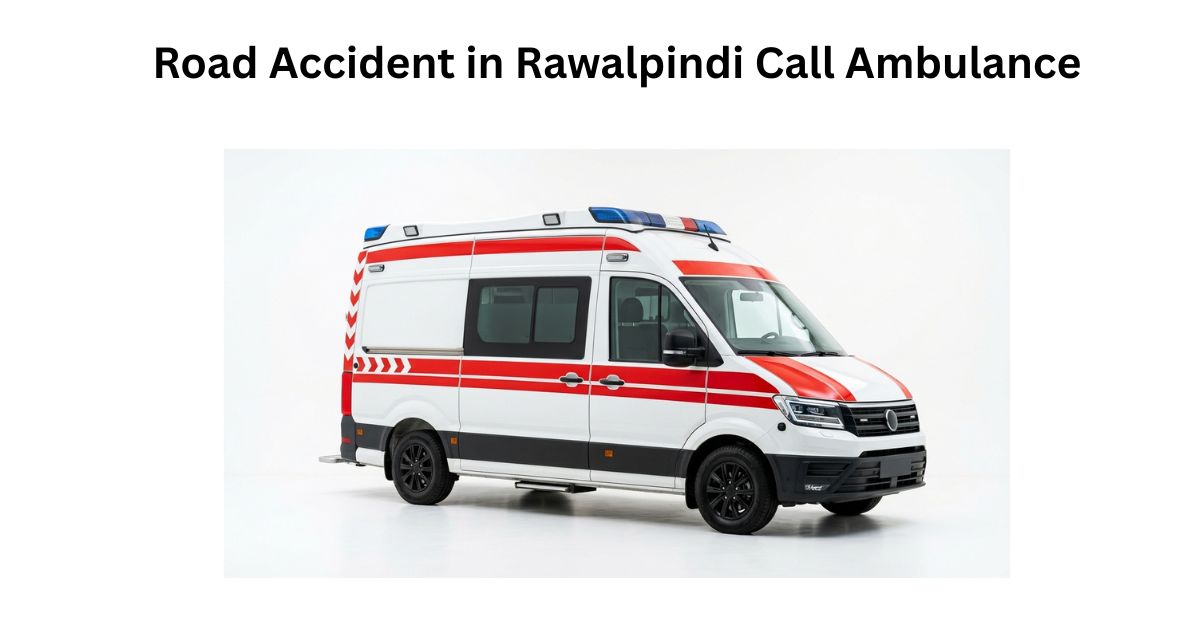
Road Accident in Rawalpindi: What to Do and How to Call Emergency Ambulance
📋 Table of Contents
- Emergency Numbers to Call in Rawalpindi
- Who to Call First at a Road Accident
- Step 1: Make the Scene Safe
- Step 2: How to Call the Ambulance Correctly
- Step 3: Safe First Aid You Can Give
- Do's and Don'ts at the Accident Scene
- Rawalpindi's Accident Hotspots
- Which Ambulance Does the Victim Need?
- Ambulance Response Times in Rawalpindi
- Hospitals We Transfer Accident Victims To
- Legal & Police Steps After an Accident
- Preventing Road Accidents in Rawalpindi
- FAQs – Road Accident in Rawalpindi
- Related Articles & Services
Rawalpindi is one of Pakistan's busiest and most congested cities. With over 2.3 million residents, narrow inner-city lanes, heavy truck traffic on the GT Road and Peshawar Road, and a constant flow of motorcycles, rickshaws, and buses, road accidents happen every single day. Some are minor scrapes. Others are catastrophic — involving head injuries, spinal trauma, fractures, and multiple casualties.
At every accident scene in Rawalpindi, a crowd gathers within seconds. Some people pull victims out of vehicles. Others pour water into unconscious mouths. Some shout for a car to take the injured to hospital. These reactions come from a genuine desire to help — but many of them cause harm that no hospital can undo. A person with a spinal injury who is pulled from a car can become permanently paralysed. A victim given water before surgery can choke or aspirate.
This guide is written for every Rawalpindi resident — driver, rider, pedestrian, and bystander. It explains exactly what to do after a road accident, how to call an emergency ambulance correctly, what first aid helps and what harms, and how to prepare the scene so that help arrives faster. Read it once now. In an emergency, you won't have time to search for this information.
⭐ Save These Rawalpindi Emergency Numbers
Insaf Ambulance (ICU / Oxygen / ALS)
Rescue 1122 (Government) — 1122
Edhi Foundation — 115
Chhipa Welfare — 1020
Police Emergency — 15
Motorway Police (M-1, M-2) — 130
Fire Brigade — 16
📞 Emergency Numbers to Call in Rawalpindi
Knowing which number to call saves critical seconds. Here is the complete list for Rawalpindi.
| Service | Number | Best For |
|---|---|---|
| Insaf Ambulance | +92 329 8041122 | ICU, oxygen, ALS, critical accident victims, intercity transfers |
| Rescue 1122 | 1122 | Free general emergency, vehicle extrication, fires, rescue |
| Edhi Foundation | 115 | Free ambulance, mass casualties |
| Chhipa Welfare | 1020 | Free ambulance, community response |
| Police | 15 | Accident report, traffic control, FIR |
| Motorway Police | 130 | Accidents on M-1 (Islamabad–Peshawar) and M-2 |
| Fire Brigade | 16 | Fire, fuel leakage, trapped victims |
🚨 Who to Call First at a Road Accident
The order of calls matters. Calling in the wrong sequence wastes precious minutes.
| Priority | Who to Call | Why |
|---|---|---|
| 1st | Ambulance (if anyone is injured) | Medical emergencies are time-critical — every minute of delay costs lives and limbs |
| 2nd | Rescue 1122 (if victims are trapped) | Trained for vehicle extrication with hydraulic cutters and spreaders |
| 3rd | Police (15) | Required for the accident report and legal procedures |
| 4th | Family of the victims | To inform next of kin and gather documents |
| 5th | Insurance company | To file a claim and arrange vehicle towing |
🛡️ Step 1: Make the Scene Safe
Your safety comes first. You cannot help anyone if you become a second victim — and secondary accidents at Rawalpindi accident scenes are tragically common.
Step 2 – Turn on hazard lights: Warn oncoming vehicles immediately.
Step 3 – Place a warning triangle: 30–50 metres behind the accident scene, if you have one.
Step 4 – Wear something reflective: A reflective vest, or a light-coloured cloth if unavailable.
Step 5 – Assess for hazards: Fire, smoke, fuel leaks, broken glass, downed power lines, unstable vehicles.
Step 6 – Do NOT smoke: A cigarette near a fuel leak can cause a fire.
Step 7 – Ask bystanders to flag traffic: Wave oncoming vehicles to slow down.
Step 8 – Call Motorway Police (130) if on a motorway for lane management and traffic control.
📞 Step 2: How to Call the Ambulance Correctly
What you say to the dispatcher determines how quickly and how appropriately help arrives. In Rawalpindi, vague locations are the single biggest cause of ambulance delay.
2. Give your exact location: Road name, sector, landmark, and nearest intersection.
3. Send a Google Maps pin via WhatsApp immediately after the call ends.
4. State the number of casualties: "One injured" or "multiple casualties."
5. Describe severity: "Conscious," "unconscious," "bleeding heavily," "trapped in vehicle."
6. Mention hazards: Fire, fuel leak, blocked lane, oncoming traffic.
7. Mention vehicle types: Car, motorcycle, truck, bus, rickshaw.
8. Give your callback number and stay reachable.
9. Stay on the line until the dispatcher confirms dispatch and gives an ETA.
10. Send someone to the main road to guide the ambulance to the exact spot.
Rawalpindi Location Examples – Vague vs Precise
| ❌ Vague (Causes Delay) | ✅ Precise (Fast Response) |
|---|---|
| "Near Murree Road" | "Murree Road, near 6th Road Chowk, opposite Shell pump, northbound" |
| "On Peshawar Road" | "Peshawar Road, near Westridge, opposite CMH Gate 3" |
| "In Saddar" | "Saddar, Bank Road, near Karachi Company, opposite the bank" |
| "Near the hospital" | "Outside Holy Family Hospital, main gate, Satellite Town side" |
| "On GT Road" | "GT Road, near Mandra Toll Plaza, 2 km towards Rawalpindi" |
| "Chandni Chowk area" | "Chandni Chowk flyover, underpass, Rawalpindi-bound lane" |
For a full walkthrough of how to give information to a dispatcher, see our guide on what to do while waiting for the ambulance.
🩹 Step 3: Safe First Aid You Can Give
While waiting for the ambulance, you can provide safe first aid that helps without causing harm. Here is exactly what to do for each common accident injury.
| Injury | Safe First Aid Action | Do NOT |
|---|---|---|
| Severe bleeding | Apply firm direct pressure with a clean cloth. Add layers if soaked. Elevate the limb if no fracture. | Do not remove the cloth to check. Do not use a tourniquet unless trained and bleeding is life-threatening. |
| Unconscious but breathing | Place in the recovery position (on the side). Monitor breathing. Keep warm. | Do not leave unattended. Do not give food or water. |
| Not breathing | Start CPR immediately — 100–120 compressions per minute, 5–6 cm deep. | Do not delay CPR. Do not stop until help arrives. |
| Suspected neck or spine injury | Keep completely still. Support the head in the position found. Wait for paramedics. | DO NOT MOVE THEM. This is the most common fatal mistake. |
| Fractures | Immobilise the limb in the position found. Pad with cloth. Apply a covered cold pack. | Do not try to straighten the limb. Do not move unnecessarily. |
| Burns | Cool with running water for 20 minutes. Cover with a clean non-stick dressing. | Do not apply ice, toothpaste, oil, ghee, or ointments. Do not burst blisters. |
| Shock | Lay flat, raise legs slightly. Keep warm with a blanket. Reassure continuously. | Do not give food or drink. Do not leave unattended. |
| Head injury | Keep the head still and slightly elevated. Monitor consciousness. Watch for vomiting or drowsiness. | Do not shake the person. Do not remove a helmet unnecessarily. |
| Motorcycle helmet | Leave the helmet on unless the airway is blocked. If removing, support the head and neck with two people. | Do not twist the neck. Do not pull by the visor. |
| Trapped in a vehicle | Keep the victim calm. Turn off the engine if you can safely reach the key. Wait for Rescue 1122. | Do not attempt to pull the victim out unless there is fire or immediate danger. |
✅❌ Do's and Don'ts at the Accident Scene
✅ DO These
- Make the scene safe first
- Call the ambulance immediately
- Note the time of the accident
- Control bleeding with pressure
- Keep the patient warm
- Reassure the patient constantly
- Support the head and neck
- Clear the crowd
- Guide the ambulance to the spot
- Stay with the victim
- Collect witness contact details
- Photograph the scene (after helping)
❌ DON'T Do These
- Do not move the victim unless in danger
- Do not give food or water
- Do not remove a helmet unnecessarily
- Do not crowd the patient
- Do not shake an unconscious person
- Do not straighten fractures
- Do not apply ice or toothpaste to burns
- Do not smoke near fuel leaks
- Do not film for social media
- Do not leave the scene
- Do not drive the victim yourself
- Do not argue or fight with other drivers
📍 Rawalpindi's Accident Hotspots
These roads and intersections in Rawalpindi see frequent accidents. Be extra cautious when driving through them — and if you witness an accident here, act quickly.
| Location | Common Accident Type | Main Cause |
|---|---|---|
| Murree Road | Motorcycle vs car, pedestrian | Heavy commercial traffic, bus stops, narrow stretches |
| Peshawar Road | High-speed collisions | Wide arterial road, speeding, trucks |
| GT Road (Rawalpindi section) | Truck vs car, motorcycle | Heavy transport, fatigue, overtaking |
| Committee Chowk | Intersection collisions | Signal jumping, mixed traffic |
| Chandni Chowk | Multi-vehicle pile-ups | Flyover and underpass merging, high speed |
| 6th Road / Satellite Town | Motorcycle accidents | Dense traffic, pedestrians, narrow lanes |
| Saddar / Bank Road | Pedestrian vs vehicle | Crowded commercial area, parking |
| Raja Bazaar / Old City | Rickshaw and motorcycle | Extremely narrow lanes, no traffic separation |
| Adiala Road | High-speed collisions | Long straight road, mixed traffic |
| Mandra-Chakwal Road | Truck accidents, overturning | Heavy goods vehicles, curves |
| Islamabad Expressway (Rawalpindi end) | High-speed multi-vehicle | Fast traffic, merging at Faizabad |
| M-1 Motorway (near Rawalpindi) | Fog-related pile-ups | Low visibility in winter, speeding |
📊 Common Road Accident Injuries in Rawalpindi (% of cases)
*Approximate distribution based on Rawalpindi hospital and ambulance data.
🚑 Which Ambulance Does the Victim Need?
Not every accident victim needs the same level of care. Describing the injuries accurately helps the dispatcher send the right ambulance.
| Ambulance Type | Best For | Equipment |
|---|---|---|
| BLS Ambulance | Stable victims with minor injuries | Oxygen, stretcher, first aid, suction, EMT |
| ALS Ambulance | Moderate trauma, cardiac concerns | Cardiac monitor, defibrillator, IV drugs, paramedic |
| ICU Ambulance | Severe trauma, unconscious, head injury, unstable vitals | Ventilator, multi-param monitor, infusion pumps, critical care nurse |
| Rescue 1122 | Victims trapped in vehicles (extrication) | Hydraulic cutters, spreaders, rescue tools + BLS ambulance |
For serious accidents in Rawalpindi, an ALS or ICU ambulance is recommended because accident victims can deteriorate rapidly — especially those with head injuries, internal bleeding, or suspected spinal trauma. When calling, describe the injuries accurately: "unconscious," "heavy bleeding from the head," "cannot move legs." This helps the dispatcher send the appropriate level of care.
⏱️ Ambulance Response Times in Rawalpindi
Response time depends on your exact location, traffic, and ambulance availability. Here is an estimated guide for 2027.
⏱️ Estimated Ambulance Response Times in Rawalpindi (minutes)
*Estimates vary by traffic, weather, and ambulance availability. Inner-city areas with narrow streets may take longer.
How to Speed Up the Ambulance Arrival
- 📍 Send a Google Maps pin: Send your live location via WhatsApp after calling
- 🚧 Send someone to the main road: A guide saves 5–10 minutes
- 🗣️ State severity clearly: "Unconscious," "heavy bleeding," "trapped" prioritises the call
- 📞 Stay on the line: The dispatcher may give first aid instructions
- 🚗 Clear traffic: Ask bystanders to make way for the ambulance
- 🔦 Use hazards and torches: Help the ambulance spot the location at night
- 🛣️ Mention road closures: If a procession or construction is blocking access
🏥 Hospitals We Transfer Accident Victims To
We provide ambulance transport to and from all major hospitals in Rawalpindi and Islamabad, including trauma centres.
Rawalpindi Hospitals
- 🏥 Combined Military Hospital (CMH) Rawalpindi — trauma, neurosurgery, orthopaedics, ICU
- 🏥 Holy Family Hospital — emergency, general surgery, ICU
- 🏥 Benazir Bhutto Hospital — trauma, burns, emergency
- 🏥 Fauji Foundation Hospital — trauma, cardiac, general surgery
- 🏥 District Headquarters (DHQ) Hospital — general emergencies
- 🏥 Railway Hospital Rawalpindi — general, cardiac
- 🏥 Al-Shifa Trust Eye Hospital — eye injuries from accidents
Islamabad Hospitals (Frequently Used for Serious Trauma)
- 🏥 Pakistan Institute of Medical Sciences (PIMS) — major trauma centre, neurosurgery, ICU
- 🏥 Shifa International Hospital — trauma, orthopaedics, neuro, ICU
- 🏥 Quaid-e-Azam International Hospital — multi-specialty, ICU
- 🏥 Polyclinic Hospital — general emergency
Choice of hospital depends on the injuries:
- 🧠 Head injury: Needs a hospital with CT scanner and neurosurgery (CMH, PIMS, Shifa)
- 🦴 Fractures: Orthopaedic-capable facility
- 🔥 Burns: Benazir Bhutto Hospital has a burn unit
- 👁️ Eye injuries: Al-Shifa Trust Eye Hospital
- 🩸 Severe trauma: PIMS or CMH trauma centre
For complex critical patients requiring a higher level of care, we also coordinate transfers to Lahore (Mayo, Jinnah, PIC). See our guide on how to transfer a patient from Rawalpindi to Lahore safely.
⚖️ Legal & Police Steps After an Accident
Road accidents in Pakistan involve legal procedures. Here is what every driver should know.
2. Do NOT flee the scene: Leaving is a criminal offence under the Pakistan Penal Code.
3. Exchange information: Names, CNIC numbers, vehicle registration, insurance details.
4. Document the scene: Photographs of vehicles, positions, damage, and road conditions — after helping the injured.
5. Collect witness details: Names and phone numbers of anyone who saw the accident.
6. Obtain a medical report: For all injured parties — essential for any legal claim.
7. File an FIR: At the nearest police station for serious accidents or any injury.
8. Cooperate with the investigation: Provide accurate information; do not tamper with evidence.
9. Keep all documents: Ambulance invoice, hospital bills, medical reports, photographs.
10. Inform your insurer: Promptly, to protect your claim.
For Hit-and-Run Victims
- 🚨 Call an ambulance first — medical care is the priority
- 📞 Report to police immediately with any details you remember about the vehicle
- 📸 Check for CCTV: Nearby shops and buildings often have cameras
- 👥 Ask witnesses: Anyone who saw the vehicle, driver, or number plate
- 📋 File the FIR without delay — delays reduce the chance of finding the driver
- 🏥 Keep all medical records for compensation claims
🛡️ Preventing Road Accidents in Rawalpindi
The best way to handle a road accident is to prevent one. Follow these safety practices on Rawalpindi roads.
- 🪖 Always wear a helmet: Motorcyclists and pillion riders — even for short trips
- 💺 Wear seatbelts: All passengers, all seats
- 📱 Never use a mobile phone while driving
- 🚦 Respect traffic signals: Do not jump red lights, especially at Committee Chowk, Chandni Chowk, and 6th Road
- 🚗 Maintain a safe following distance: At least a two-second gap
- 🌧️ Slow down in rain: Rawalpindi roads become slippery and drain poorly
- 🌫️ Use fog lights in winter: Visibility drops sharply on GT Road and the motorway
- 😴 Do not drive tired: Especially on long hauls and after night shifts
- 🚫 Never drink and drive
- 🔧 Maintain your vehicle: Brakes, tyres, lights, wipers, horn
- 🚸 Watch for pedestrians and cyclists: Especially around markets, schools, and bus stops
- 🐄 Watch for animals: Livestock on rural and peri-urban roads
- 🌙 Be extra careful at night: Poor lighting on many Rawalpindi roads
- 📚 Learn basic first aid and CPR: You may be the only person able to help
❓ Frequently Asked Questions – Road Accident in Rawalpindi
1. Who should I call first after a road accident in Rawalpindi?
If anyone is injured, call an ambulance FIRST. Call Insaf Ambulance at +92 329 8041122, Rescue 1122 at 1122, or Edhi at 115. Then call the police at 15. Medical emergencies are time-critical — help the injured before dealing with legal procedures. If victims are trapped in a vehicle, also call Rescue 1122 for extrication.
2. Should I move an injured person from the accident scene?
No — unless there is immediate danger such as fire, oncoming traffic, or the risk of explosion. Moving a person with a suspected spinal injury can cause permanent paralysis. Keep them still, support the head and neck in the position found, and wait for paramedics with proper immobilisation equipment. Do not pull anyone out of a vehicle unless there is a fire or other immediate danger.
3. What should I do if the victim is bleeding heavily?
Apply firm direct pressure to the wound with a clean cloth or sterile gauze and hold continuously for at least 10 minutes without lifting the cloth to check. If it soaks through, add more layers on top rather than removing the first. Elevate the limb if there is no fracture. Keep the patient warm and monitor for signs of shock. A tourniquet should only be used for life-threatening limb bleeding, applied 5–7 cm above the wound, and the time must be noted.
4. Should I remove a motorcycle rider's helmet after an accident?
Leave the helmet on unless the airway is blocked by vomit or blood, or the victim is not breathing and requires CPR. Removing a helmet incorrectly can cause or worsen a neck and spine injury. If removal is essential, use two people — one supports the head and neck while the other gently slides the helmet off (never pulling by the visor) — keeping the head in line with the spine.
5. What legal steps must I take after a road accident in Rawalpindi?
Call police at 15 and file an FIR at the nearest police station. Do not flee the scene — it is a criminal offence. Exchange information with other drivers (name, CNIC, vehicle number, insurance). Document the scene with photographs and collect witness contact details. Obtain a medical report for all injured parties. Keep the ambulance invoice, hospital bills, and all documents for insurance and any legal claim. Cooperate fully with the investigation.
🔗 Related Articles & Our Ambulance Services
Our Services:
🚑 Ambulance Service in Pakistan✈️ Airport Ambulance Service
🎪 Event Medical Coverage Pakistan
🏥 ICU Ambulance Service
Helpful Articles:
⏱️ What to Do While Waiting for the Ambulance: Pakistan Emergency Guide🧠 Stroke Emergency in Pakistan: Every Second Counts — Call Ambulance First
🚑 How to Transfer a Patient from Rawalpindi to Lahore Safely
🚨 Emergency Ambulance in Faisalabad: Private vs Government Services
🚑 Save this number — it could save a life on Rawalpindi's roads.
📞 Call: +92 329 8041122 💬 WhatsApp UsICU, ALS, Oxygen & BLS ambulances with spinal immobilisation equipment — 24/7 emergency response across Rawalpindi, Islamabad & all major highways.
© Insaf Ambulance Services – Rapid, Reliable, and Compassionate Emergency Care Across Pakistan.