


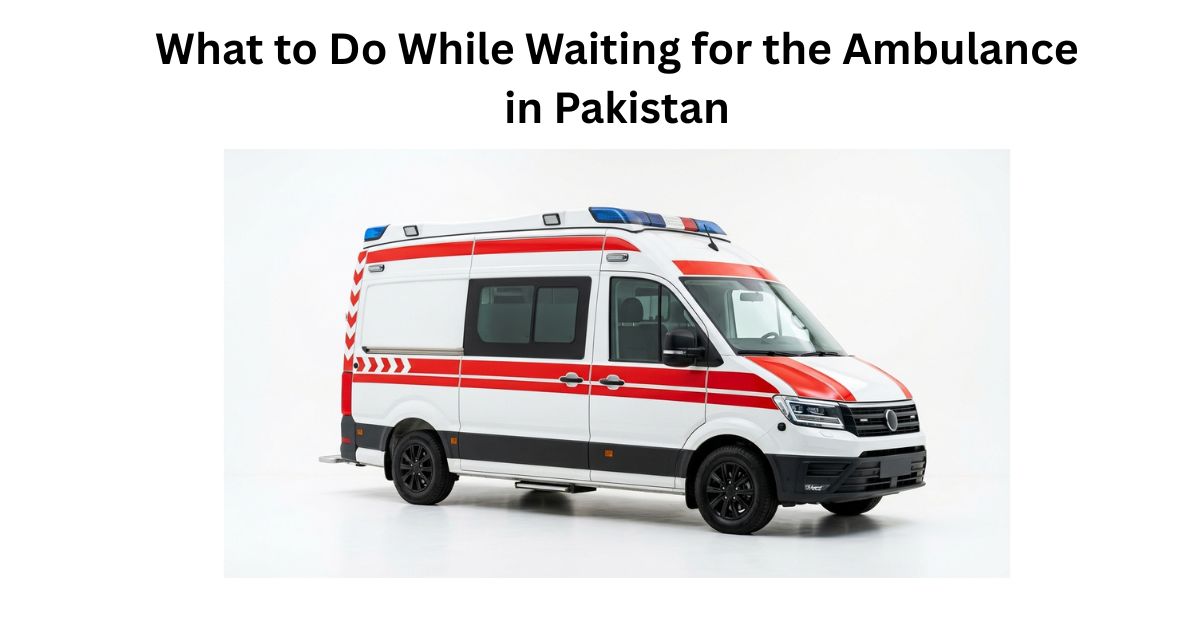
What to Do While Waiting for the Ambulance: Pakistan Emergency Guide
📋 Table of Contents
- Why Waiting Time Matters So Much
- First Steps Immediately After Calling
- CPR for Cardiac Arrest
- Bleeding Control
- Heart Attack – What to Do
- Stroke – What to Do
- Breathing Difficulty & Choking
- Unconscious but Breathing – Recovery Position
- Seizures, Burns, and Fractures
- Preparing for the Ambulance Arrival
- Do's and Don'ts While Waiting
- Handing Over to Paramedics
- FAQs – Waiting for the Ambulance
- Related Articles & Services
Every medical emergency has a silent countdown. From the moment you call an ambulance, the clock is running — and what happens in the next ten to thirty minutes often determines whether the patient survives, recovers fully, or suffers permanent damage. In Pakistan, where ambulance response times can extend to 25–40 minutes during peak traffic, this waiting period can be dangerously long.
Most families panic during this time. Some rush the patient into a car. Some pour water into an unconscious person's mouth. Some shake an accident victim "to wake them up." Others do nothing at all, frozen by fear. Each of these responses — or lack of response — can cause harm that no hospital can undo.
This guide gives you a clear, practical playbook for what to do while waiting for an ambulance in Pakistan. It covers CPR, bleeding control, heart attack and stroke actions, the recovery position, choking relief, and the dangerous mistakes to avoid. Read it once now — and you'll be prepared when it matters. Insaf Ambulance dispatchers also coach callers through basic first aid while the ambulance is en route.
🚨 Emergency? Call now — we'll guide you while the ambulance is on the way.
📞 Call: +92 329 8041122 💬 WhatsApp Us⏱️ Why Waiting Time Matters So Much
The wait for an ambulance is not "dead time" — it is active treatment time. For many emergencies, the patient's outcome is largely determined before professional help arrives.
- ❤️ Cardiac arrest: Survival drops by roughly 10% for every minute without CPR and defibrillation
- 🧠 Stroke: Around 1.9 million brain cells are lost every minute
- 🩸 Severe bleeding: A major artery can cause fatal blood loss within minutes
- 🫁 Airway obstruction: Brain damage begins within 3–4 minutes without oxygen
- 🔥 Burns: Cooling within the first 20 minutes reduces burn depth and scarring
- 💉 Anaphylaxis: Can be fatal within 5–15 minutes if epinephrine isn't given
- 🌡️ Heat stroke: Mortality exceeds 80% if cooling is delayed beyond an hour
📉 Survival Rate vs Time to CPR (Cardiac Arrest)
*Approximate survival rates for out-of-hospital cardiac arrest. Bystander CPR is the single biggest factor.
⭐ The Golden Principle
While waiting for the ambulance: protect the airway, stop severe bleeding, and start CPR if the patient isn't breathing normally. Everything else — documents, paperwork, traffic arguments — can wait.
📋 First Steps Immediately After Calling
The moment the call ends, your job begins. Follow these steps in order.
Step 2 – Send your location: Immediately send a WhatsApp location pin to the dispatcher's number, even if you already explained the address.
Step 3 – Clear the path: Send someone to the main road or gate to guide the ambulance. This saves 5–10 minutes.
Step 4 – Unlock everything: Main gate, building entrance, apartment door. Remove obstacles for the stretcher.
Step 5 – Assess the patient: Check responsiveness, breathing, and bleeding.
Step 6 – Begin first aid: CPR if not breathing, pressure if bleeding, recovery position if unconscious but breathing.
Step 7 – Gather documents: CNIC, medical reports, medication list, hospital cards, cash.
Step 8 – Note the time: Especially important for stroke and cardiac events.
Step 9 – Assign roles: One person stays with the patient, one handles the phone, one watches for the ambulance.
Step 10 – Calm the patient: Reassure them constantly. Anxiety worsens cardiac and respiratory distress.
❤️ CPR for Cardiac Arrest
If the patient is unresponsive and not breathing normally (or only gasping), start CPR immediately. Hands-only CPR is safe and effective for untrained bystanders.
Step 2 – Check breathing: Look at the chest for no more than 10 seconds. Occasional gasps are NOT normal breathing.
Step 3 – Position: Lay the person flat on their back on a firm surface.
Step 4 – Hand placement: Heel of one hand in the centre of the chest (lower half of the breastbone), other hand on top, fingers interlocked.
Step 5 – Posture: Kneel beside them, arms straight, shoulders directly above your hands.
Step 6 – Push hard and fast: Depth 5–6 cm, rate 100–120 compressions per minute.
Step 7 – Full recoil: Let the chest rise completely between compressions.
Step 8 – Minimise pauses: Keep interruptions under 10 seconds.
Step 9 – Rotate rescuers: Swap every 2 minutes if someone else is available.
Step 10 – Continue: Do not stop until the ambulance arrives, an AED is applied, or the person shows signs of life.
CPR by Age Group
| Parameter | Adult | Child (1–12 yrs) | Infant (<1 yr) |
|---|---|---|---|
| Rate | 100–120/min | 100–120/min | 100–120/min |
| Depth | 5–6 cm | ~5 cm (⅓ of chest) | ~4 cm (⅓ of chest) |
| Hands | Two hands, centre of chest | One or two hands | Two fingers, below nipple line |
| Ratio (if trained) | 30:2 | 30:2 | 30:2 |
| Hands-only acceptable? | ✅ Yes | ✅ Yes (untrained) | ⚠️ Prefer 30:2 |
🩸 Bleeding Control
Severe bleeding is one of the fastest ways to lose a life. Control it in the first minute.
Step 2 – Direct pressure: Press firmly on the wound with a clean cloth or sterile gauze.
Step 3 – Do not lift: If the cloth soaks through, add more layers on top — never remove the first layer.
Step 4 – Elevate: If it's a limb and there's no fracture, raise it above heart level.
Step 5 – Maintain pressure: Hold continuously for at least 10 minutes without checking.
Step 6 – Tourniquet (life-threatening limb bleeding only): Apply 5–7 cm above the wound, tighten until bleeding stops, note the time.
Step 7 – Keep the patient warm: Prevent shock with a blanket.
Step 8 – Monitor consciousness: Watch for signs of shock — pale skin, rapid weak pulse, confusion.
💔 Heart Attack – What to Do While Waiting
Time is heart muscle. Every minute of delay causes permanent damage — or death.
Step 2 – Loosen tight clothing: Collar, tie, scarf, belt.
Step 3 – Give aspirin: 300 mg chewed (not swallowed whole) — if conscious, not allergic, not bleeding, and not already on aspirin.
Step 4 – Do NOT give food or water.
Step 5 – Reassure and calm: Anxiety increases cardiac workload.
Step 6 – Note the onset time: Critical for hospital treatment decisions.
Step 7 – Keep them warm and still.
Step 8 – If they become unresponsive and stop breathing normally: start CPR immediately.
Aspirin guidance: Chewing 300 mg of regular aspirin is safe for most suspected heart attack patients and reduces clot progression. However, do NOT give it if the patient has a known aspirin allergy, active bleeding, a bleeding disorder, or is already on blood thinners without medical advice.
🧠 Stroke – What to Do While Waiting
Recognise stroke with FAST — Face drooping, Arm weakness, Speech difficulty, Time to call for help. If any sign is present, treat it as a stroke.
Step 2 – Keep them calm and lying on their side: If vomiting or drowsy, the recovery position protects the airway.
Step 3 – Do NOT give food, water, or aspirin: Swallowing may be impaired; aspirin worsens bleeding strokes.
Step 4 – Loosen tight clothing.
Step 5 – Do not let them sleep it off.
Step 6 – Keep them warm.
Step 7 – Reassure constantly: Stroke patients are often frightened and disoriented.
Step 8 – If they become unresponsive and stop breathing: start CPR.
⭐ The Stroke Time Rule
Clot-busting treatment is usually given within 3–4.5 hours of symptom onset, and mechanical thrombectomy may be possible up to 24 hours in selected patients. The time you note when you call can literally determine whether the patient can be treated.
🫁 Breathing Difficulty & Choking
Severe Breathing Difficulty
- 🪑 Sit the patient upright: This opens the chest and eases breathing
- 🪟 Open windows and loosen clothing
- 💊 Help with their inhaler if they have asthma and it's prescribed for them
- 🧘 Coach slow breathing: "In through the nose, out through pursed lips"
- 📉 Check SpO₂ if you have a pulse oximeter; below 92% needs urgent oxygen
- 🚫 Do not lay them flat — this worsens breathlessness
Choking (Adult or Child)
Step 2 – If they cannot breathe, speak, or cough: give 5 firm back blows between the shoulder blades with the heel of your hand.
Step 3 – If not cleared: give 5 abdominal thrusts (Heimlich manoeuvre) — fist just above the navel, pull sharply inward and upward.
Step 4 – Alternate: 5 back blows and 5 abdominal thrusts until the object clears or the patient becomes unresponsive.
Step 5 – If they become unresponsive: lower them to the floor and start CPR.
Infants (<1 yr): 5 back blows and 5 chest thrusts — NOT abdominal thrusts.
😴 Unconscious but Breathing – Recovery Position
If the patient is unresponsive but breathing normally, protect the airway by placing them on their side. This prevents the tongue from blocking the airway and reduces choking risk if they vomit.
Step 2: Place the arm nearest to you at a right angle to the body.
Step 3: Bring the far arm across the chest, hand near the cheek.
Step 4: Bend the far knee up.
Step 5: Gently roll them towards you onto their side.
Step 6: Tilt the head slightly back to keep the airway open.
Step 7: Monitor breathing continuously until help arrives.
⚡ Seizures, Burns, and Fractures
| Emergency | What to Do | What NOT to Do |
|---|---|---|
| Seizure | Clear surrounding objects; cushion the head; time the seizure; place in recovery position afterwards | Do not restrain; do not put anything in the mouth; do not give water during the seizure |
| Burns | Cool with running water for 20 minutes; remove jewellery and loose clothing near the burn; cover with clean non-stick dressing | Do not apply ice, toothpaste, oil, ghee, or ointments; do not burst blisters |
| Fractures | Immobilise the limb in the position found; pad with cloth; support with a splint; apply a covered cold pack | Do not try to straighten the limb; do not move unnecessarily |
| Head injury | Keep the head still; monitor consciousness and pupils; watch for vomiting or drowsiness | Do not shake the person; do not remove a helmet unnecessarily |
| Suspected spinal injury | Keep completely still; support the head in the position found; wait for paramedics | Do not move unless in immediate danger (fire, traffic) |
| Heat stroke | Move to shade; remove excess clothing; spray with cool water and fan; apply cold packs to neck, armpits, groin | Do not give aspirin or paracetamol; do not leave unattended |
| Hypoglycemia (diabetic) | If conscious and able to swallow, give sugar, glucose tablets, or sweet drink | Do not give anything by mouth if unconscious or unable to swallow |
🏠 Preparing for the Ambulance Arrival
The seconds saved during preparation are often as valuable as the first aid itself.
- 🚪 Open all doors and gates: Main gate, building entrance, lift lobby, apartment door
- 🛗 Reserve an elevator: Ask building security to hold one for the medical crew
- 🚗 Clear parking access: Ask neighbours to move vehicles blocking the route
- 👥 Send a guide: One person at the main road, holding a phone torch at night
- 🐕 Secure pets: So they don't interfere with paramedics
- 📄 Gather documents: CNIC, medication list, recent reports, imaging films, insurance
- 💰 Arrange payment: Cash or card for ambulance and initial hospital expenses
- 🧥 Pack a small bag: Warm shawl, spare clothes, phone charger, water
- 🩸 Clear the patient's area: Move furniture so the stretcher can reach them
- 📞 Keep the phone free: The driver may call for directions
- 👨👩👧 Inform relatives: Let family know which hospital you're heading to
✅❌ Do's and Don'ts While Waiting
✅ DO These
- Stay calm and speak slowly
- Follow dispatcher instructions
- Start CPR if not breathing normally
- Apply firm pressure to bleeding
- Keep the patient warm
- Reassure and comfort them
- Note the time symptoms started
- Send a WhatsApp location pin
- Send someone to guide the ambulance
- Clear the path for the stretcher
- Gather documents and medications
- Keep monitoring breathing and consciousness
❌ DON'T Do These
- Do not delay calling to "wait and see"
- Do not move an accident victim unnecessarily
- Do not give food or water to an unconscious person
- Do not give aspirin for a suspected stroke
- Do not put anything in a seizing person's mouth
- Do not apply ice, oil, or toothpaste to burns
- Do not remove a motorcycle helmet roughly
- Do not crowd the patient
- Do not film for social media
- Do not let the patient walk or climb stairs during a heart attack
- Do not drive yourself for a critical emergency
- Do not hang up on the dispatcher too early
🤝 Handing Over to Paramedics
A clear handover helps the medical team act immediately. Use the SBAR format used by emergency professionals.
| Element | What to Say | Example |
|---|---|---|
| S – Situation | What is happening now | "He collapsed 12 minutes ago and is still unconscious." |
| B – Background | Relevant history | "He is 62, diabetic, on insulin and BP medication." |
| A – Assessment | What you observed | "He wasn't breathing, so I started CPR. He started gasping after 4 minutes." |
| R – Recommendation | What you think is needed | "Please take him to a hospital with a cardiac cath lab." |
Additional details to hand over: time of onset, medications given (aspirin, sugar, inhaler), allergies, whether an AED was used, and how many shocks were delivered. Then step back and let the crew work. If you're family, prepare to follow the ambulance to the hospital.
For a step-by-step guide on preparing the patient for a long transfer, see our article on how to transfer a patient from Rawalpindi to Lahore safely.
❓ Frequently Asked Questions – What to Do While Waiting for the Ambulance
1. What is the most important thing to do while waiting for an ambulance?
Check whether the patient is breathing normally. If they are unresponsive and not breathing normally — or only gasping — start hands-only CPR immediately at 100–120 compressions per minute, 5–6 cm deep, in the centre of the chest. If they are breathing but bleeding heavily, apply firm direct pressure. Airway, breathing, and bleeding control come before everything else.
2. Should I move the patient while waiting for the ambulance?
No — unless there is immediate danger such as fire, oncoming traffic, or drowning. Moving a patient with a suspected spinal injury can cause permanent paralysis. Keep them still, support the head and neck, and wait for paramedics with proper immobilisation equipment. If you absolutely must move them, keep the head, neck, and body in line and use multiple rescuers.
3. Can I give water or food to the patient while waiting?
No. Do not give food or water to anyone who is unconscious, drowsy, confused, or likely to need emergency surgery. Swallowing may be impaired, causing choking, and an empty stomach is required for anaesthesia. The only exception is a conscious patient with low blood sugar, who may be given sugar or a sweet drink.
4. What should I do for someone having a heart attack while waiting for the ambulance?
Keep them seated or semi-reclined, loosen tight clothing, and give 300 mg of aspirin to chew if they are conscious, not allergic, not bleeding, and not already on aspirin. Do not let them walk or climb stairs. Note the time symptoms started and reassure them. If they become unresponsive and stop breathing normally, start CPR immediately.
5. How do I prepare for the ambulance arrival?
Send a WhatsApp location pin to the dispatcher, send someone to the main road to guide the driver, open all gates and doors, reserve an elevator, clear a path for the stretcher, secure pets, and gather documents (CNIC, medication list, medical reports, insurance cards) and cash. Keep your phone reachable so the driver can call for directions, and clear furniture around the patient so the stretcher can reach them.
🔗 Related Articles & Our Ambulance Services
Our Services:
🚑 Ambulance Service in Pakistan✈️ Airport Ambulance Service
🎪 Event Medical Coverage Pakistan
🏥 ICU Ambulance Service
Helpful Articles:
👴 Ambulance Service for Elderly Patients in Rawalpindi and Islamabad💉 Ambulance for Dialysis Patients in Rawalpindi and Islamabad
🚑 How to Transfer a Patient from Rawalpindi to Lahore Safely
🚨 Emergency Ambulance in Faisalabad: Private vs Government Services
🚑 Call first — then act. We'll guide you while help is on the way.
📞 Call: +92 329 8041122 💬 WhatsApp UsICU, Oxygen, ALS & Patient Transport ambulances with trained paramedics — 24/7 across Pakistan, with live first-aid guidance on the phone.
© Insaf Ambulance Services – Rapid, Reliable, and Compassionate Emergency Care Across Pakistan.