


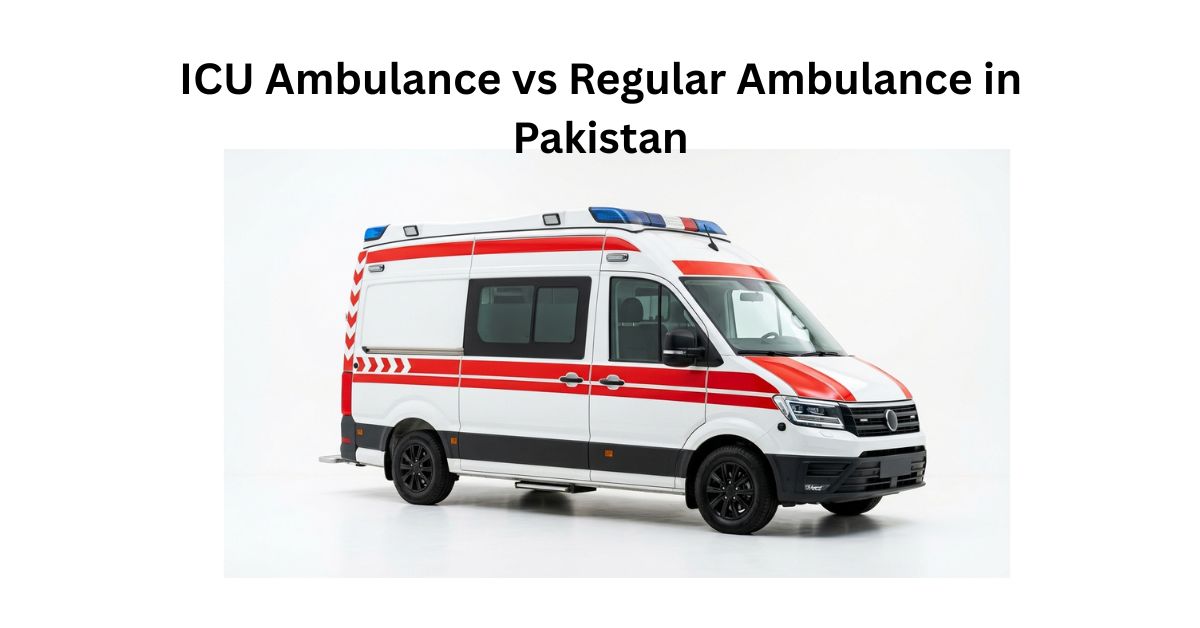
ICU Ambulance vs Regular Ambulance in Pakistan: Which Do You Need?
📋 Table of Contents
- What Is a Regular Ambulance?
- What Is an ICU Ambulance?
- ICU vs Regular Ambulance – Full Comparison
- Equipment Comparison Table
- Staff Comparison
- When a Regular Ambulance Is Enough
- When You Need an ICU Ambulance
- Cost Comparison in Pakistan (2027)
- How to Choose in an Emergency
- FAQs – ICU vs Regular Ambulance
- Related Articles & Services
When a medical emergency strikes in Pakistan, families often face a confusing question: should we call a regular ambulance or an ICU ambulance? The answer can be the difference between life and death — but many people don't know the difference until it's too late.
A regular ambulance (also called BLS or Basic Life Support) provides a stretcher, oxygen, first aid, and trained EMTs — adequate for stable patients who need transport. An ICU ambulance is a mobile intensive care unit, carrying a ventilator, cardiac monitor, defibrillator, infusion pumps, and critical care staff — essential for patients who are critically ill, unstable, or ventilator-dependent.
Calling a regular ambulance for a heart attack or stroke victim wastes critical minutes and limits the patient's chances of survival. Conversely, paying for an ICU ambulance for a stable patient wastes money and puts unnecessary strain on critical care resources. This guide explains exactly how to choose correctly — with real equipment comparisons, staffing details, costs in Pakistan, and clear decision rules.
🚑 Not sure which ambulance you need? Call us — we'll guide you.
📞 Call: +92 329 8041122 💬 WhatsApp Us🚑 What Is a Regular Ambulance?
A regular ambulance — technically called a Basic Life Support (BLS) ambulance — is the most common type of emergency medical vehicle in Pakistan. It is designed to safely transport patients who are stable or have non-life-threatening conditions.
What a regular ambulance typically carries:
- 🛏️ Stretcher and wheelchair: For patient mobility
- 🫁 Oxygen cylinder and masks: Basic oxygen therapy
- 🩹 First aid kit: Bandages, antiseptics, dressings
- 🩸 Suction machine: For airway clearance
- 🧤 Basic gloves and masks: Infection control
- 📡 Communication device: Radio or phone to dispatch
- 🧑⚕️ EMT (Emergency Medical Technician): Basic life support training
What a regular ambulance does NOT carry:
- ❌ Cardiac monitor / ECG
- ❌ Defibrillator
- ❌ Ventilator
- ❌ Infusion pumps
- ❌ Advanced airway kit (intubation)
- ❌ Full emergency drug kit
- ❌ Critical care nurse or doctor
🏥 What Is an ICU Ambulance?
An ICU ambulance — also called a mobile intensive care unit or critical care transport — is a highly specialized vehicle designed to provide hospital-level intensive care during transport. It is the highest level of medical transport available on the road.
What an ICU ambulance carries:
- 🫁 Transport ventilator: For patients who cannot breathe independently
- 📈 Multi-parameter monitor: Continuous ECG, BP, SpO₂, temperature
- ⚡ Defibrillator: For cardiac arrest and arrhythmias
- 💉 Infusion pumps (2–4): Precise drug delivery
- 🫁 Advanced airway kit: Intubation, laryngoscope, supraglottic airways
- 💊 Full emergency drug kit: Vasopressors, sedatives, ACLS drugs
- 🔋 Onboard power: Inverter/generator for continuous equipment operation
- 🌡️ Climate control: Temperature regulation for patient stability
- 🧑⚕️ Critical care nurse and/or doctor: Advanced training in ICU care
⭐ The Simple Difference
Regular ambulance: Gets the patient to the hospital safely.
ICU ambulance: Brings the hospital's intensive care unit to the patient — and keeps them alive during transport.
📊 ICU vs Regular Ambulance – Full Comparison
Here's a complete side-by-side comparison of the two ambulance types.
| Feature | Regular (BLS) Ambulance | ICU Ambulance |
|---|---|---|
| Purpose | Safe transport of stable patients | Critical care during transport |
| Oxygen | ✅ Basic oxygen | ✅ High-flow + ventilator |
| Cardiac Monitor | ❌ No | ✅ Multi-parameter |
| Defibrillator | ❌ No | ✅ Yes |
| Ventilator | ❌ No | ✅ Transport ventilator |
| Infusion Pumps | ❌ No | ✅ 2–4 pumps |
| Advanced Airway Kit | 🟡 Basic | ✅ Full intubation kit |
| Emergency Drugs | 🟡 Minimal | ✅ Full ACLS drug kit |
| Staff | EMT | Critical care nurse/paramedic, optional doctor |
| Power Backup | 🟡 Limited | ✅ Inverter/generator |
| Climate Control | 🟡 Basic | ✅ Full climate regulation |
| Typical Cost (city) | PKR 4,000 – 8,000 | PKR 15,000 – 30,000 |
| Best For | Stable patients, minor injuries, discharge | Critical, unstable, ventilated, post-surgery |
📊 Level of Care – Regular vs ICU Ambulance
*Relative capability to manage critical patients during transport.
🧰 Equipment Comparison Table
Here's the detailed equipment breakdown that makes the two ambulance types so different.
| Equipment | Regular Ambulance | ICU Ambulance | Why It Matters |
|---|---|---|---|
| Transport Ventilator | ❌ | ✅ | Patients who cannot breathe independently need mechanical ventilation |
| Multi-Parameter Monitor | ❌ | ✅ | Detects arrhythmias and deterioration instantly |
| Defibrillator | ❌ | ✅ | Restarts heart in cardiac arrest |
| Infusion Pumps | ❌ | ✅ | Precise delivery of vasopressors and sedatives |
| Advanced Airway Kit | 🟡 Basic | ✅ Advanced | Intubation when the patient deteriorates |
| Emergency Drugs | 🟡 Basic | ✅ Full ACLS | Immediate treatment during transport |
| Suction Machine | ✅ | ✅ | Airway clearance |
| Oxygen Cylinders | 🟡 Basic | ✅ High-capacity + high-flow | Long-distance oxygen support |
| Power Inverter/Generator | 🟡 Limited | ✅ Full | Equipment cannot stop mid-transport |
| Climate Control | 🟡 Basic | ✅ Full regulation | Prevents hypothermia/hyperthermia |
🧑⚕️ Staff Comparison
The equipment is only half the story. What separates a regular ambulance from an ICU ambulance is who is on board.
| Staff Member | Regular Ambulance | ICU Ambulance |
|---|---|---|
| Driver | ✅ Trained driver | ✅ Trained emergency driver |
| EMT | ✅ Basic life support | ✅ Critical care paramedic |
| Nurse | ❌ No | ✅ ICU nurse (optional) |
| Doctor | ❌ No | ✅ Available with additional cost |
| Skills | CPR, oxygen, first aid, immobilization | Ventilator management, cardiac monitoring, drug titration, intubation |
| Training | Basic EMT certification | Critical care paramedic + nurse/doctor |
What ICU ambulance staff can do during transport:
- 📈 Interpret cardiac rhythms and adjust treatment
- 🫁 Manage ventilator settings based on patient's condition
- 💉 Titrate vasoactive infusions (dopamine, noradrenaline)
- 🩸 Administer blood products if needed
- ⚡ Defibrillate or pace the heart
- 🫁 Perform emergency intubation
- 💊 Administer resuscitation medications
- 🩺 Make clinical decisions when the patient deteriorates
✅ When a Regular Ambulance Is Enough
A regular ambulance is perfectly adequate — and often the more appropriate choice — in these situations:
- 🩹 Minor injuries: Cuts, sprains, minor fractures
- 🌡️ Fever or illness: Stable patients with fever, flu, or other non-critical illness
- 🤕 Stable road accident victims: Minor collisions, conscious and stable patients
- 🏥 Hospital discharge: Moving stable patients home after treatment
- 💊 Dialysis: Routine transport for stable dialysis patients
- 🎗️ Chemotherapy appointments: Stable cancer patients going for routine treatment
- 👴 Elderly with basic needs: Mobility assistance for non-critical patients
- 🩺 Follow-up visits: Stable patients going for checkups
- 🦴 Non-emergency transfers: Stable patient moved between hospitals or facilities
- 🚶 Conscious, breathing normally: Patient is alert, oriented, and comfortable
🔴 When You Need an ICU Ambulance
An ICU ambulance is essential — not optional — in these situations:
- 🫁 Ventilator-dependent patient: Cannot breathe without mechanical support
- ❤️ Heart attack (acute MI): Needs cardiac monitor, defibrillator, IV drugs
- 🧠 Stroke: Requires oxygen, monitoring, and rapid transport
- 🫁 Severe respiratory distress: Needs high-flow oxygen or ventilation
- 🩸 Severe trauma: Multiple injuries, internal bleeding, spinal injuries
- ⚡ Unstable cardiac rhythm: Requires continuous monitoring and possible defibrillation
- 💉 Receiving vasoactive medications: Continuous infusion of dopamine, noradrenaline, etc.
- 🩺 Post-major surgery: After cardiac, neurosurgery, or transplant
- 👶 Neonatal emergencies: Premature or critically ill newborns
- 🩸 Severe bleeding: Requires blood products and monitoring
- 🧠 Unconscious/head injury: Needs airway management and monitoring
- 🔄 Intercity transfer of critical patient: Long-distance transport requiring ICU care throughout
- 🫘 Organ failure: Kidney, liver, or multi-organ support
- 🤰 High-risk pregnancy complications: Severe pre-eclampsia, eclampsia
⭐ Critical Decision Rule
If your patient needs a ventilator, continuous cardiac monitoring, or has unstable vital signs — you need an ICU ambulance. Free BLS services (1122, Edhi) are excellent for stable patients but cannot provide this level of care. Do not compromise medical necessity to save money.
💰 Cost Comparison in Pakistan (2027)
ICU ambulances cost significantly more than regular ambulances because of the equipment and staffing involved. Here are indicative rates for 2027.
| Service Type | Within City | Intercity (100–300 km) | Long Distance (300+ km) |
|---|---|---|---|
| Regular BLS Ambulance | PKR 4,000 – 8,000 | PKR 15,000 – 35,000 | PKR 35,000 – 55,000 |
| Oxygen Ambulance | PKR 6,000 – 12,000 | PKR 20,000 – 40,000 | PKR 40,000 – 65,000 |
| ALS Ambulance | PKR 8,000 – 15,000 | PKR 25,000 – 50,000 | PKR 50,000 – 80,000 |
| ICU Ambulance | PKR 15,000 – 30,000 | PKR 50,000 – 90,000 | PKR 90,000 – 1,50,000 |
| ICU with Doctor | PKR 25,000 – 40,000 | PKR 80,000 – 1,20,000 | PKR 1,20,000 – 1,90,000 |
| Neonatal ICU Ambulance | PKR 20,000 – 35,000 | PKR 65,000 – 1,00,000 | PKR 1,00,000 – 1,50,000 |
💰 Within-City Cost Comparison (PKR)
*Indicative averages for within-city transfers in major Pakistani cities, 2027.
What you're paying for in an ICU ambulance:
- 🚑 Equipment: Ventilator alone costs PKR 15–40 lakh; monitor, defibrillator, pumps add millions more
- 🧑⚕️ Staff: Critical care nurses and paramedics command higher salaries
- 💊 Medications: Vasopressors, sedatives, and other emergency drugs used during transport
- 🫁 Oxygen: Large quantities consumed by critically ill patients
- 🔧 Maintenance: Specialized equipment requires regular calibration and servicing
- 📞 Coordination: Pre-notification and hospital coordination for the critical patient
💡 Money-saving tip: For non-emergency transfers — dialysis, chemotherapy, hospital discharge, airport pickups — a regular or BLS ambulance is often sufficient. Save the ICU ambulance cost for situations that genuinely need it. For financial assistance options, see our guide on affording private ambulances.
🎯 How to Choose in an Emergency
When you're facing an emergency, decision-making is hard. Here's a simple decision guide.
| Situation | Best Choice | Why |
|---|---|---|
| Conscious, breathing, stable | 🟢 Regular ambulance | Adequate for stable patients |
| Minor injury, walking | 🟢 Regular ambulance | No critical care needed |
| Fever, flu, minor illness | 🟢 Regular ambulance | Stable, no monitoring needed |
| Dialysis, chemo, discharge | 🟢 Regular ambulance (pre-booked) | Planned, stable patient |
| Heart attack / chest pain | 🔴 ICU or ALS ambulance | Needs cardiac monitor + defibrillator |
| Stroke (FAST signs) | 🔴 ICU or ALS ambulance | Needs oxygen + monitoring + rapid transport |
| Ventilated patient | 🔴 ICU ambulance only | Needs ventilator + critical care staff |
| Severe breathing difficulty | 🔴 Oxygen or ICU ambulance | Needs high-flow oxygen |
| Severe trauma / accident | 🔴 ICU or ALS ambulance | Needs monitoring + advanced airway capability |
| Unconscious patient | 🔴 ICU ambulance | Needs airway management + monitoring |
| Post-major surgery transfer | 🔴 ICU ambulance | Needs continuous monitoring |
| Neonatal emergency | 🔴 Neonatal ICU ambulance | Needs incubator + neonatal ventilator |
1. Call an ambulance and describe the patient's condition clearly.
2. The dispatcher will recommend the appropriate ambulance type based on your information.
3. If the patient is critical, ask for an ICU ambulance — don't settle for a BLS unit.
4. If the patient is stable, a regular ambulance will be sufficient and save money.
5. When in doubt, err on the side of caution — request ICU.
❓ Frequently Asked Questions – ICU vs Regular Ambulance in Pakistan
1. What is the main difference between an ICU ambulance and a regular ambulance?
A regular (BLS) ambulance provides a stretcher, basic oxygen, first aid, and an EMT — adequate for stable patients. An ICU ambulance provides ventilator support, cardiac monitoring, defibrillation, infusion pumps, and critical care staff — essential for critically ill, unstable, or ventilator-dependent patients. The ICU ambulance is essentially a mobile intensive care unit.
2. When should I call an ICU ambulance instead of a regular ambulance?
Call an ICU ambulance if the patient is on a ventilator, has unstable heart rhythm, is receiving vasoactive drugs, is recovering from major surgery, has severe trauma, or has reduced consciousness. If the patient is conscious, breathing normally without assistance, and stable — a regular ambulance is likely sufficient. When in doubt, err on the side of caution and request ICU.
3. How much more does an ICU ambulance cost than a regular ambulance?
Within a city, a regular ambulance costs PKR 4,000–8,000, while an ICU ambulance costs PKR 15,000–30,000 — about 3–5 times more. Intercity ICU transfers cost PKR 50,000–1,90,000. The higher cost reflects the millions of rupees of equipment and higher-paid critical care staff required. Call +92 329 8041122 for an exact quote.
4. Can a regular ambulance carry a heart attack patient?
It can — but it shouldn't. A heart attack patient needs continuous cardiac monitoring, a defibrillator on standby, oxygen, and emergency drugs. A regular ambulance lacks all of these except basic oxygen. For any suspected heart attack, request an ALS or ICU ambulance. The difference in care can be life-saving, particularly if the patient goes into cardiac arrest en route.
5. What if I'm not sure which ambulance to call?
Call +92 329 8041122 and describe the patient's condition clearly. Our dispatcher will recommend the appropriate ambulance type based on the patient's symptoms, age, consciousness, breathing, and medical history. When in doubt, it's always safer to request an ICU ambulance — a critical patient transported in a BLS ambulance may deteriorate without proper monitoring and treatment.
🔗 Related Articles & Our Ambulance Services
Our Services:
🚑 Ambulance Service in Pakistan✈️ Airport Ambulance Service
🎪 Event Medical Coverage Pakistan
🏥 ICU Ambulance Service
Helpful Articles:
🚗 Road Safety in Pakistan: How to Help After an Accident Without Making It Worse⏱️ Golden Hour in Medical Emergencies: Why Ambulance Speed Saves Lives
🚦 Ambulance Etiquette in Pakistan: How to Make Way for Emergency Vehicles
🌡️ Heatwave Medical Emergencies in Pakistan: How Ambulance Services Respond
🚑 The right ambulance can save a life. Call us now.
📞 Call: +92 329 8041122 💬 WhatsApp UsBLS, ALS, Oxygen, ICU & Neonatal ambulances — we'll help you choose the right one for your emergency. 24/7 across Pakistan.
© Insaf Ambulance Services – Rapid, Reliable, and Compassionate Emergency Care Across Pakistan.