


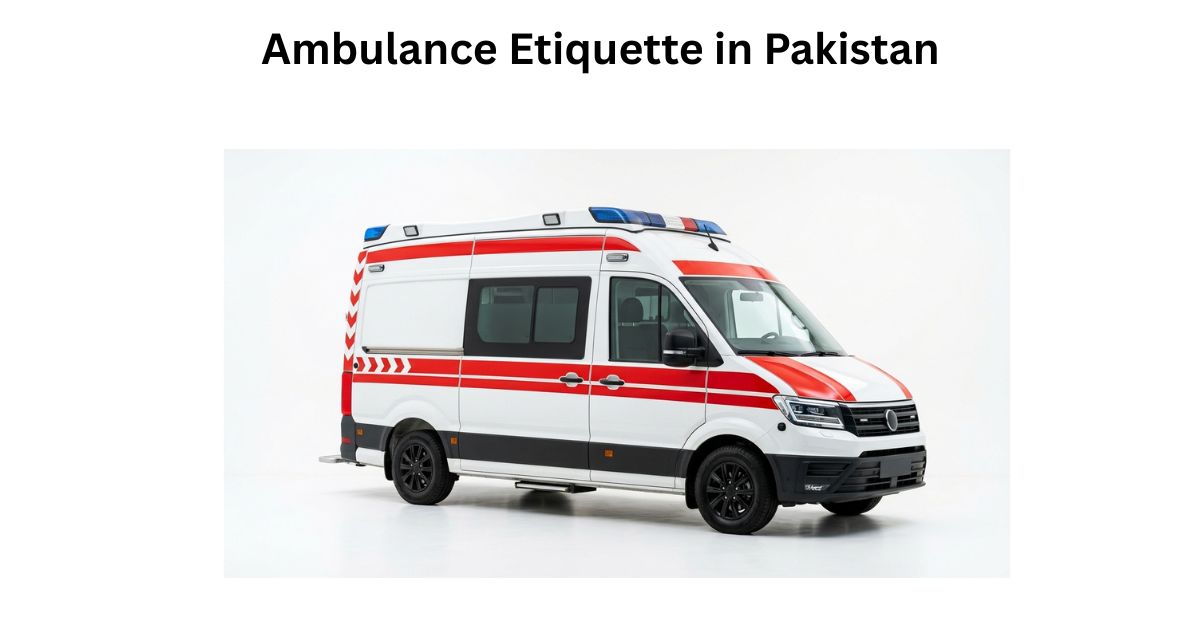
Ambulance Etiquette in Pakistan: How to Make Way for Emergency Vehicles
📋 Table of Contents
- Why Ambulance Etiquette Matters in Pakistan
- Legal Obligations – Right of Way Laws
- What to Do When You Hear an Ambulance Siren
- Lane Discipline – How to Clear the Way
- Traffic Signal & Intersection Etiquette
- Motorway & Highway Etiquette
- Pedestrian & Motorcycle Etiquette
- When You're Behind an Ambulance
- Common Mistakes That Delay Ambulances
- Legal Penalties for Obstruction
- FAQs – Ambulance Etiquette in Pakistan
- Related Articles & Services
Every day in Pakistan, ambulances race against time — carrying heart attack victims, stroke patients, accident casualties, and critically ill newborns to hospitals. Every minute counts. Yet in cities like Karachi, Lahore, Rawalpindi, and Islamabad, ambulances are frequently blocked by traffic, ignored at intersections, and delayed by drivers who don't know — or don't care — about ambulance etiquette.
The consequences are real. Studies worldwide show that every minute of ambulance delay reduces survival rates for cardiac arrest by 10%. In Pakistan, where traffic congestion already extends response times dramatically, poor etiquette on the road adds another layer of preventable tragedy. A driver who doesn't move over may be delaying help for someone else's mother, father, or child — perhaps one day, their own.
This guide is written for every Pakistani driver, motorcyclist, and pedestrian. It explains exactly what to do when you see or hear an ambulance, the legal obligations under Pakistani law, common mistakes that delay emergency vehicles, and the simple, life-saving actions that take just seconds. Ambulance etiquette isn't just good manners — it's a civic duty that saves lives.
🚦 Why Ambulance Etiquette Matters in Pakistan
Traffic in Pakistan's major cities is chaotic at the best of times. When an ambulance appears with sirens blaring and lights flashing, the response of surrounding drivers determines whether it reaches the patient — and the hospital — in time.
Why every second matters:
- ❤️ Cardiac arrest: Survival drops 10% every minute without CPR/defibrillation
- 🧠 Stroke: 1.9 million brain cells die every minute without treatment
- 🩸 Severe bleeding: Blood loss accelerates rapidly; minutes determine survival
- 🫁 Respiratory failure: Every minute without oxygen causes irreversible damage
- 👶 Neonatal emergencies: Premature babies have limited time before complications
- 🚗 Accident victims: Golden hour for trauma care — delays cost lives
📊 Survival Rate vs Ambulance Response Time (Cardiac Arrest)
*Illustrative survival rates based on typical out-of-hospital cardiac arrest outcomes. Ambulance delays directly reduce survival.
⭐ The Golden Rule of Ambulance Etiquette
When you see or hear an ambulance, assume it is responding to a life-or-death emergency. Every second you delay it may be someone's last.
⚖️ Legal Obligations – Right of Way Laws in Pakistan
In Pakistan, giving way to emergency vehicles isn't just courtesy — it's a legal obligation. Here are the relevant laws and penalties.
Relevant Laws
- 📜 National Highways Safety Ordinance 2000: Mandates right of way for emergency vehicles
- 📜 Motor Vehicles Ordinance 1965: Requires drivers to give way to ambulances and other emergency vehicles
- 📜 Provincial Traffic Rules: Punjab, Sindh, KP have specific rules for emergency vehicle priority
- 📜 Pakistan Penal Code (PPC): Obstruction of emergency services can be prosecuted as a public nuisance
- 📜 Motorway Police Act: Ambulances have priority on motorways; obstruction is a punishable offense
What the Law Requires You to Do
- 🚦 Give right of way to any ambulance with lights or sirens
- 🛣️ Move to the side of the road as soon as safely possible
- 🚫 Do not block intersections when an ambulance is approaching
- 🚗 Do not follow closely behind an ambulance to "ride the wave" through traffic
- 🚙 Do not overtake an ambulance that is responding to an emergency
- 🚶 Pedestrians must clear crosswalks when an ambulance is approaching
- 🚴 Motorcyclists must move to the side and stop when safe
• Heavy fines (PKR 5,000–50,000 depending on province)
• License suspension for repeat offenses
• Vehicle impoundment in serious cases
• Prosecution under PPC if obstruction results in harm
• Additional charges if the obstruction causes death or injury
🔊 What to Do When You Hear an Ambulance Siren
The moment you hear a siren or see flashing lights, you have seconds to react. Follow this protocol.
Step 2 – Stay calm: Do not panic or make sudden, unsafe maneuvers.
Step 3 – Signal your intention: Use indicators to show you're moving over.
Step 4 – Slow down gradually: Don't slam on the brakes — that could cause an accident.
Step 5 – Move to the side: Pull over to the left or right as safely possible.
Step 6 – Stop if necessary: If the ambulance needs the full road, stop and wait.
Step 7 – Wait until the ambulance passes: Do not resume driving until it's clearly past.
Step 8 – Do not follow: Resist the urge to tail the ambulance through traffic.
If You're at an Intersection
- 🚦 Do NOT enter the intersection if an ambulance is approaching
- 🚦 If already in the intersection, clear it so the ambulance can pass
- 🚦 Do not block cross traffic — clear the path for the ambulance
- 🚦 Wait for the ambulance to pass before proceeding, even if your light turns green
🛣️ Lane Discipline – How to Clear the Way
In Pakistan, lane discipline is often poor. When an ambulance approaches, knowing exactly how to create a path can save critical seconds.
The "Clear the Middle" Principle
Most ambulances need a clear central path. Here's how to help create it:
| Your Position | What to Do | Why |
|---|---|---|
| Left lane | Stay left, move slightly further left if possible | Clears the middle for the ambulance |
| Right lane | Stay right, move slightly further right if possible | Clears the middle for the ambulance |
| Middle lane | Move to whichever side has more space | Creates a central path |
| Blocking an intersection | Clear immediately, even if it means moving through a red light cautiously | Ambulance needs to pass |
| Stuck in a jam | Move as far as possible to the side, even onto the shoulder if safe | Every inch helps |
| Parked vehicles | Do not double-park; if you hear an ambulance, move if possible | Double-parked cars block ambulance routes |
⭐ The "Two-Car Width" Rule
If two vehicles on either side of a lane both pull to their respective sides, the middle will be wide enough for an ambulance to pass safely. Think of your vehicle as one side of the gate — pull aside, and the gate opens.
Special Situations
- 🚧 Narrow roads: Pull over as far as possible; if the ambulance can't pass, stop and wait
- 🛣️ One-way streets: Same rules apply — move to the side
- 🌉 Bridges: Do not stop on the bridge — move to the side and continue slowly if no room
- 🕳️ Potholes and construction: Move carefully — don't endanger yourself
- 🚦 Roundabouts: Yield to the ambulance; do not enter if it's approaching
- 🅿️ Parking areas: Clear a path for the ambulance to enter/exit
🚦 Traffic Signal & Intersection Etiquette
Intersections are where most ambulance delays occur in Pakistani cities. Here's how to help.
| Situation | Your Action | Reasoning |
|---|---|---|
| Ambulance behind you at a red light | If safe, move slightly forward/side to clear path; do NOT run the red light unsafely | Ambulance can pass if there's room |
| Ambulance approaching on cross street | Wait, even if your light is green | Ambulance has right of way |
| You're in the intersection when ambulance approaches | Clear the intersection immediately if safe | Don't block the path |
| Ambulance stuck at red light | If you can safely move to create a path, do so | Ambulances can proceed through red lights cautiously in Pakistan |
| Pedestrian crossing at a signal | Stop and wait; do not cross if an ambulance is approaching | Clear the path |
| Ambulance entering a roundabout | Yield; do not block the entrance | Ambulance needs to keep moving |
🛣️ Motorway & Highway Etiquette
Motorway and highway driving is faster — and more dangerous. Here's how to give way to ambulances on Pakistan's highways.
Motorway Etiquette
- 🛣️ Stay in your lane until it's safe to move
- 🚦 Signal clearly before changing lanes
- 🚗 Do not overtake on the shoulder — this blocks ambulances that may use the shoulder
- 🔦 Use hazard lights briefly to indicate you're slowing/moving over
- 📞 Call 130 (Motorway Police) if you witness an accident or blocked ambulance
- 🚫 Do not tailgate — leave space for emergency vehicles
- 🛑 If you have an accident, move to the shoulder immediately
Highway (GT Road, N-5, etc.) Etiquette
- 🚦 Move to the shoulder if possible
- 🛣️ Slow down as the ambulance approaches
- 🚫 Do not block narrow sections
- 🌙 At night, flash headlights briefly to warn others
- 🚗 Do not overtake the ambulance
- 📞 Report accidents to 130 and call for medical help
Motorway Accidents – What to Do
2. Turn on hazard lights.
3. Place warning triangle behind your vehicle if safe.
4. Call 130 (Motorway Police) and +92 329 8041122 for ambulance.
5. Do not stand on the road — stand behind the barrier if available.
6. Do not move injured persons unless in immediate danger.
7. Note the exact kilometer marker for accurate location.
🚶 Pedestrian & Motorcycle Etiquette
Pedestrians and motorcyclists are particularly vulnerable — but they also play a critical role in giving way.
Pedestrian Etiquette
- 🚦 Do not cross if you hear an ambulance siren
- 🛑 Clear the crosswalk immediately if an ambulance is approaching
- 👂 Stay alert — remove headphones, avoid phone distractions
- 👀 Look both ways before crossing, even on green signals
- 🚸 Move to the sidewalk if possible
- 🩺 If someone is injured, call an ambulance — don't move them
- 🚑 Wave the ambulance through if you're at a crossing
Motorcycle Etiquette
- 🛣️ Move to the side immediately when you hear a siren
- 🚫 Do not weave through traffic to try to get ahead
- 🪖 Wear a helmet — always
- 🛑 Do not stop in the middle of the road — pull to the side
- 🚦 At intersections, clear the path
- 🛣️ On highways, stay out of the shoulder lane when an ambulance may need it
- 📞 Report accidents you witness — call 1122, 115, or +92 329 8041122
🚗 When You're Behind an Ambulance
Following behind an ambulance may seem like a clever way to get through traffic faster — but it's dangerous, illegal, and unethical.
Why You Must NOT Follow an Ambulance
- 🚫 It's illegal: Following an emergency vehicle is a punishable offense
- ⚠️ It's dangerous: Ambulances make sudden turns, U-turns, and lane changes
- 🚦 It causes accidents: Drivers behind you may not expect your sudden movements
- 🚑 It blocks access: If the ambulance needs to stop or reverse, you're in the way
- 👮 You may be fined: Traffic police can penalize you
- 🚑 It delays other ambulances: Multiple emergencies may need the same route
- 😞 It's unethical: You're exploiting someone's emergency for personal convenience
What to Do Instead
- 🛣️ Maintain normal driving — go your own way at normal speed
- 🚦 Wait your turn at traffic signals
- 🧘 Stay patient — the ambulance's destination isn't yours
- 🚗 Use alternate routes if your road is congested
- 📞 Report traffic issues to local authorities if necessary
🚫 Common Mistakes That Delay Ambulances
These mistakes are common on Pakistani roads — and they cost lives.
✅ DO These
- Pull to the side immediately
- Wait at intersections
- Clear crosswalks
- Signal your intention
- Stop if the ambulance needs full road
- Let the ambulance pass completely
- Use hazard lights if needed
- Guide others to make way
- Report accidents
- Stay calm and alert
❌ DON'T Do These
- Block the ambulance
- Speed up to stay ahead
- Tail the ambulance through traffic
- Use the ambulance's path to overtake others
- Stop in the middle of the road
- Honk back at the ambulance
- Take photos/videos while driving
- Move to the wrong side unsafely
- Assume "someone else will move"
- Ignore the siren
Top 10 Mistakes That Delay Ambulances
| Mistake | Impact | How to Fix |
|---|---|---|
| Ignoring the siren | Ambulance stuck behind your car | Act immediately when you hear it |
| Blocking intersections | Ambulance can't cross | Clear immediately if you can |
| Following the ambulance | Dangerous driving, blocks path | Stay back, maintain normal speed |
| Double parking on narrow roads | Ambulance cannot pass | Don't double park; move if you hear siren |
| Panicking and stopping abruptly | Causes new accidents | Slow down gradually, move to side |
| Not moving at all | Ambulance blocked | Move to side even if partially |
| Speeding up to stay in front | Dangerous, illegal | Let the ambulance pass |
| Stopping in the middle lane | Blocks the path | Move to a side lane |
| Using ambulance path to overtake others | Blocks ambulance, dangerous | Don't exploit emergency for personal gain |
| Assuming "someone else will move" | No one moves, ambulance stuck | Act yourself — don't wait for others |
⚖️ Legal Penalties for Obstructing Ambulances in Pakistan
Obstructing an ambulance isn't just bad etiquette — it's a legal offense in Pakistan. Here are the penalties under different laws.
| Province / Law | Penalty | Notes |
|---|---|---|
| Punjab Traffic Rules | Fine up to PKR 5,000–10,000 | First offense |
| Sindh Traffic Rules | Fine up to PKR 5,000–15,000 | Repeat offenses escalate |
| Khyber Pakhtunkhwa Traffic Rules | Fine up to PKR 5,000–10,000 | License points deducted |
| Motorway Police Act | Fine up to PKR 20,000 + possible vehicle impoundment | For motorway obstruction |
| Pakistan Penal Code (Section 283) | Fine up to PKR 5,000 + possible imprisonment | Public nuisance / obstruction |
| PPC (if obstruction causes harm) | Significant fines + possible imprisonment up to 3 years | If obstruction leads to injury/death |
❓ Frequently Asked Questions – Ambulance Etiquette in Pakistan
1. What should I do when I hear an ambulance siren while driving?
Immediately look around to identify where the ambulance is coming from. Slow down gradually, signal your intention, and move to the left or right side of the road — whichever is safest and creates the clearest path. If there isn't room to pass, stop completely. Do not follow behind the ambulance. Let it pass completely before resuming normal driving.
2. Is it illegal to not give way to an ambulance in Pakistan?
Yes. Under the National Highways Safety Ordinance, Motor Vehicles Ordinance, and provincial traffic rules, all drivers are legally required to give right of way to emergency vehicles. Penalties range from PKR 5,000 to PKR 50,000 in fines, license points, and in serious cases, prosecution under the Pakistan Penal Code if the obstruction results in harm.
3. Should I break a red light to let an ambulance pass?
No — you should not run a red light unsafely. If there is room to move slightly forward or to the side without endangering yourself or others, do so carefully. Most ambulances in Pakistan can and will navigate around stationary vehicles at a red light. Only move if it's clearly safe. Do not create a new accident trying to help.
4. What is the fine for blocking an ambulance in Pakistan?
Fines vary by province and offense severity. Generally, blocking an ambulance in city traffic can result in fines of PKR 5,000–15,000. On motorways, the Motorway Police can impose fines up to PKR 20,000 plus vehicle impoundment. If the obstruction results in injury or death, prosecution under the Pakistan Penal Code can result in imprisonment up to 3 years and significant fines.
5. Can I follow an ambulance to get through traffic faster?
Absolutely not. Following an ambulance is illegal, dangerous, and unethical. Ambulances make sudden turns, stops, and lane changes that can cause accidents. Followers often block the ambulance's path, delay its response, and cause harm to themselves and others. Pakistan's traffic laws prohibit this, and police can penalize offenders. Never tail an ambulance — especially not on a motorcycle.
🔗 Related Articles & Our Ambulance Services
Our Services:
🚑 Ambulance Service in Pakistan✈️ Airport Ambulance Service
🎪 Event Medical Coverage Pakistan
🏥 ICU Ambulance Service
Helpful Articles:
🚑 Ambulance from PIMS to Lahore: Fare, Route & What to Pack🆓 Free Ambulance Services in Pakistan: Complete List (Edhi, Chhipa, 1122)
🚨 Emergency Medical Services in Pakistan: Current State and Future
🌊 Emergency Ambulance in Karachi: What You Need to Know
🚑 Save a life on the road — make way for ambulances.
📞 Call: +92 329 8041122 💬 WhatsApp UsICU, Oxygen, ALS & Patient Transport ambulances — when you see us on the road, every second you give us saves a life.
© Insaf Ambulance Services – Rapid, Reliable, and Compassionate Emergency Care Across Pakistan.