


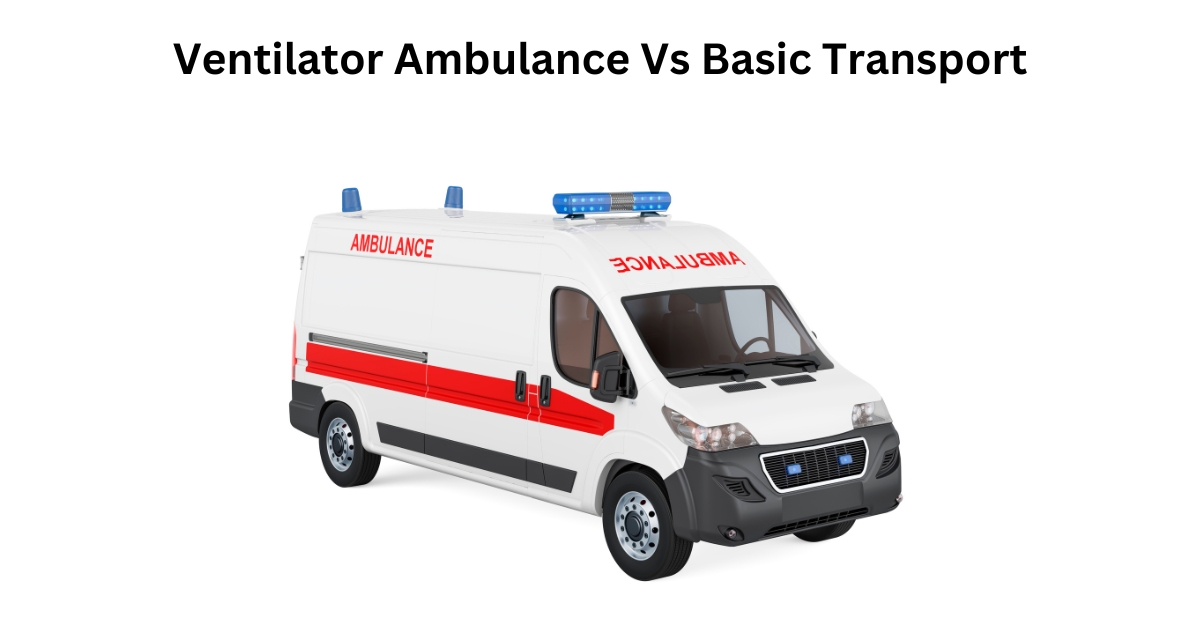
Ventilator Ambulance vs Basic Transport — When Does a Patient Need Critical Care?
- Why This Decision Matters
- Basic Ambulance (BLS) — What It Provides
- Advanced Life Support (ALS) — The Middle Ground
- Ventilator Ambulance (ICU) — Full Critical Care
- Side-by-Side Comparison — BLS vs ALS vs ICU
- When to Choose Each — Decision Guide
- Red Flags — Signs a Patient Needs ICU Transport
- Costs & Transparent Pricing
- FAQs
- Related Resources
In Pakistan, ambulance services range from simple patient transport vehicles to mobile intensive care units. Choosing the wrong type can compromise patient safety — a basic ambulance lacks ventilators and advanced monitoring for critically ill patients, while an ICU ambulance is overkill for a stable discharge[reference:0]. The difference between a basic private ambulance (which carries oxygen and a stretcher) and a proper ICU ventilator ambulance (which carries a hospital-grade portable ventilator, infusion pumps, cardiac monitor, and a paramedic trained in ACLS) is not a comfort upgrade — for a ventilator-dependent patient, it is the difference between a survivable journey and one that is not[reference:1].
Yet, in Pakistan, the awareness gap around this distinction is significant. Families frequently book "the first available ambulance" or the cheapest option without understanding that most Pakistani ambulances — including many marked as "ICU ambulances" by unregulated operators — do not carry a functioning mechanical ventilator[reference:2]. A ventilator-dependent patient who appears stable in a hospital ICU is in a state of carefully maintained equilibrium — dozens of variables held constant by a bank of machines, a nursing team, and immediately accessible resuscitation equipment[reference:3]. The moment that patient is moved onto an ambulance stretcher, every one of those variables becomes a transport problem[reference:4].
This guide is designed to help you understand exactly when a patient needs a ventilator ambulance versus basic transport. We break down the equipment, staffing, costs, and clinical criteria for each level of care — so you can make an informed decision when every second counts. For immediate assistance or expert guidance, call +92 3298041122.
📞 Call +92 3298041122 💬 WhatsApp Consultation
🚨 Why This Decision Matters — The Clinical Reality
Transporting a patient who is dependent on mechanical ventilation is one of the highest-risk clinical events in medicine. One disconnected circuit, one exhausted battery, one wrong ambulance type — and the outcome can be irreversible[reference:5]. Unlike a hospital ICU, there is no crash cart at the end of the bed when something goes wrong at 90 km/h on the M-2 Motorway[reference:6].
⚠️ Common Risks During Transport
- ● Ventilator tubing disconnection — can occur under vibration[reference:7]
- ● Battery failure — portable ventilators have finite runtimes[reference:8]
- ● Endotracheal tube displacement — road bumps can dislodge tubes[reference:9]
- ● Position changes — affect respiratory mechanics[reference:10]
- ● No immediate resuscitation backup — unlike a hospital ICU[reference:11]
💡 Key Fact: 15–40% of critical patient deteriorations during transport are preventable with correct equipment and trained staff[reference:12].
🚑 Basic Ambulance (BLS) — What It Provides
A Basic Life Support (BLS) ambulance is designed for non-critical or stable patients who require stretcher transport, basic monitoring, and minimal medical intervention[reference:13]. These ambulances are commonly used for hospital discharge, dialysis appointments, routine check-ups, or transferring stable patients between facilities[reference:14].
✅ BLS Ambulance Equipment & Staffing
- ✔ Stretcher with safety straps
- ✔ Oxygen cylinder with flowmeter
- ✔ First aid kit and basic bandages
- ✔ Air conditioning (in modern fleets)
- ✔ Trained first responder or EMT (not a paramedic)[reference:15]
❌ What BLS Ambulances DO NOT Have
- ✖ Cardiac monitors
- ✖ Defibrillators
- ✖ Ventilators
- ✖ Infusion pumps[reference:16]
BLS ambulances are not suitable for patients with active cardiac issues, respiratory failure, or those requiring IV medications en route[reference:17].
🩺 Advanced Life Support (ALS) — The Middle Ground
Advanced Life Support (ALS) ambulances serve as a bridge between basic transport and full ICU care. They are staffed by highly skilled paramedics, nurses, or even ICU doctors and carry advanced equipment[reference:18]. ALS is for critically ill patients who need continuous monitoring and advanced medical care during transport[reference:19].
✅ ALS Ambulance Equipment & Staffing
- ✔ Ventilators and suction units
- ✔ ECG and cardiac monitors
- ✔ IV fluids and medications
- ✔ Defibrillators
- ✔ Advanced airway management tools
- ✔ Infusion pumps[reference:20]
🚨 When to Use an ALS Ambulance
- ● Patient is unstable or critically ill
- ● Cardiac arrest
- ● Severe trauma or burns
- ● Respiratory failure
- ● Stroke or seizures
- ● ICU-to-ICU transfers[reference:21]
🏥 Ventilator Ambulance (ICU) — Full Critical Care
An ICU ambulance — also called a mobile ICU or ventilator ambulance — is a fully equipped critical care transport unit. It functions as a portable intensive care unit, allowing critically ill patients to be transferred safely between hospitals or from home to a tertiary care center[reference:22].
✅ ICU Ambulance Equipment & Staffing
- ✔ Portable mechanical ventilator (invasive and non-invasive modes)[reference:23]
- ✔ Multi-parameter cardiac monitor (ECG, SpO2, NIBP, EtCO2)[reference:24]
- ✔ Defibrillator with pacing capability[reference:25]
- ✔ Infusion pumps (syringe and volumetric)[reference:26]
- ✔ Suction unit and advanced airway equipment[reference:27]
- ✔ Emergency drug box (sedatives, vasopressors, antiarrhythmics)[reference:28]
- ✔ Critical care paramedic or nurse on board[reference:29]
- ✔ Air conditioning and power backup
- ✔ 8+ hours battery backup on ventilator[reference:30]
🚨 When is an ICU Ambulance MANDATORY?
- ● Patients on ventilators
- ● Patients with unstable vital signs
- ● Severe head trauma
- ● Post-cardiac arrest patients
- ● Neonatal ICU transport (with incubator)[reference:31]
📊 Side-by-Side Comparison — BLS vs ALS vs ICU
Here is a clear comparison of what each ambulance type offers[reference:32][reference:33]:
| Feature | Basic (BLS) | ALS | ICU (Ventilator) |
|---|---|---|---|
| Stretcher | ✅ Standard | ✅ Standard | ✅ ICU stretcher with scoop |
| Oxygen | ✅ Cylinder | ✅ High-flow | ✅ Dual cylinders + concentrator |
| Cardiac Monitor | ❌ No | ✅ ECG, SpO2, NIBP | ✅ Multi-parameter + EtCO2 |
| Ventilator | ❌ No | ✅ Portable | ✅ Advanced + battery backup |
| Defibrillator | ❌ No | ✅ AED | ✅ Advanced biphasic |
| Infusion Pumps | ❌ No | ❌ No | ✅ Syringe + volumetric |
| Staff | EMT | Paramedic | Critical Care Nurse + Paramedic |
| Rate (PKR/km) | 80 | 100 | 120 |
🤔 When to Choose Each — Practical Decision Guide
✅ Choose BLS (Basic Transport) When:
- ✔ Patient is conscious, stable, and breathing on their own[reference:34]
- ✔ Routine hospital discharge or check-up
- ✔ Dialysis or chemotherapy transport
- ✔ Stable patient transfer between facilities[reference:35]
- ✔ No need for IV medications or cardiac monitoring
🚨 Choose ALS When:
- ● Patient is unconscious, unstable, or has difficulty breathing[reference:36]
- ● Cardiac monitoring is required
- ● IV medications need to be administered en route
- ● Trauma or burn victims
- ● Stroke or seizure patients[reference:37]
- ● ICU-to-ICU transfers (when stable enough for ALS)
🚑 Choose ICU (Ventilator Ambulance) When:
- ● Patient is ventilator-dependent
- ● Patient requires continuous mechanical ventilation
- ● Severe respiratory failure or ARDS
- ● Post-cardiac arrest with need for intensive monitoring
- ● Multiple IV infusions (vasopressors, sedatives, paralytics)
- ● Any patient with unstable airway or requiring advanced airway management
🚩 Red Flags — Signs a Patient Needs ICU Transport
If you observe any of these signs, do not book a basic ambulance. The patient needs an ICU ventilator ambulance:
- 🚨 Patient is on a ventilator or has an artificial airway (endotracheal tube, tracheostomy)
- 🚨 Unstable vital signs — fluctuating blood pressure, heart rate, or oxygen saturation
- 🚨 Patient requires continuous IV infusions (sedatives, vasopressors, paralytics)
- 🚨 Severe respiratory distress — rapid breathing (>30/min), use of accessory muscles[reference:38]
- 🚨 Depressed mental status — GCS < 9[reference:39]
- 🚨 Patient is post-cardiac arrest or has severe head trauma
- 🚨 Any patient being transferred from an ICU or HDU — assume they need ICU-level transport
💰 Transparent Pricing — BLS, ALS, and ICU Ambulance Rates
Insaf Ambulance Services operates on a straightforward per-kilometer pricing model[reference:40]:
| Ambulance Type | Rate (PKR/km) | Rate >300 km | Best For |
|---|---|---|---|
| BLS (Basic) | 80 PKR | 80 PKR | Stable patients, routine transport[reference:41] |
| ALS | 100 PKR | 80 PKR | Cardiac patients, trauma[reference:42] |
| ICU (Ventilator) | 120 PKR | 80 PKR | Ventilator-dependent, critical patients[reference:43] |
| Neonatal ICU | 110 PKR | 80 PKR | Premature infants, newborns[reference:44] |
💡 Special Long-Distance Discount: For all trips exceeding 300 km, the fare drops to a flat 80 PKR/km for any ambulance type — whether you choose a basic transport or a fully equipped ventilator unit[reference:45][reference:46].
💡 Example Costs:
- 20 km trip in BLS ambulance: 1,600 PKR
- 20 km trip in ICU ambulance: 2,400 PKR
- Lahore to Islamabad (370 km) in ICU ambulance: 29,600 PKR (flat 80/km rate applied)
- Rawalpindi to Karachi (1,450 km) in ICU ambulance: 116,000 PKR (flat 80/km rate applied)[reference:47]
📞 Call +92 3298041122 📱 WhatsApp +92 3298041122 ➡️ Contact us for expert advice or to book the right ambulance