


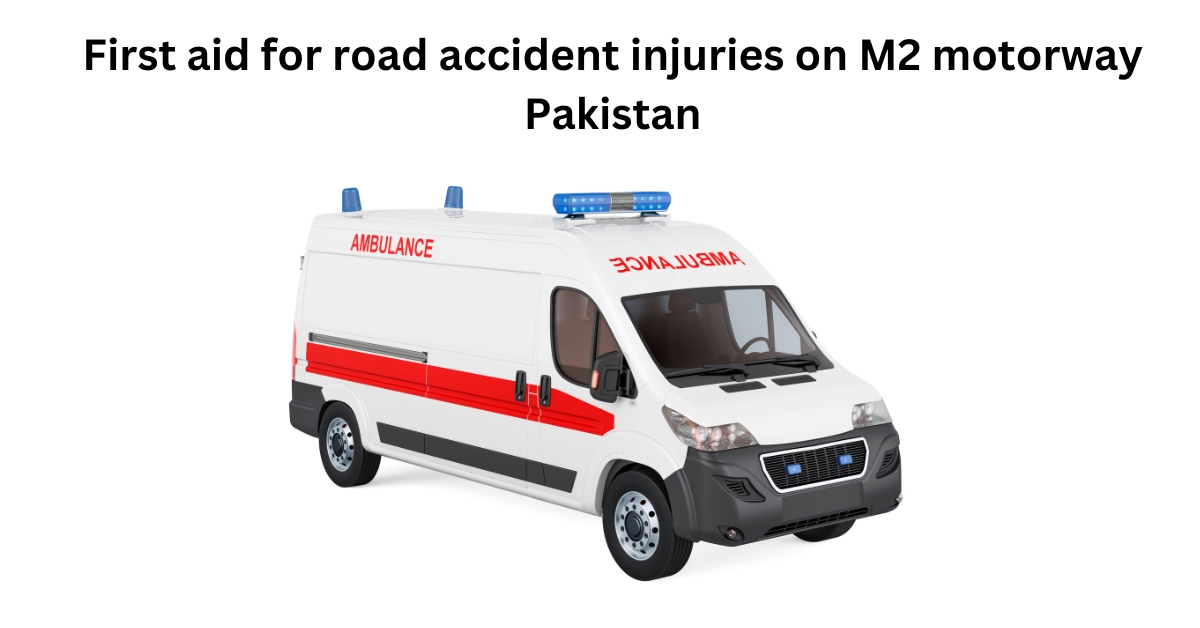
First Aid for Road Accident Injuries on M2 Motorway Pakistan — Life-Saving Guide
- M2 Motorway Overview
- Accident Statistics & Common Causes
- Scene Safety — Protect Yourself First
- Calling for Help — Who to Contact
- ABC First Aid — Airway, Breathing, Circulation
- Controlling Severe Bleeding
- Spinal Injuries — DO NOT Move
- Managing Shock
- Emergency Services on M2
- Ambulance Services & Pricing
- FAQs
- Related Resources
The M2 Motorway is Pakistan's oldest and one of its busiest motorways, stretching 367 kilometers from Lahore to Islamabad[reference:1]. It passes through major towns including Sheikhupura, Pindi Bhattian, Kot Momin, Kallar Kahar, and Chakri before ending near the twin cities[reference:2]. With high-speed traffic, heavy commercial vehicles, and sometimes unpredictable weather, the M2 sees frequent and often fatal accidents.
On July 27, 2025, at least 15 people were killed and over 30 injured in two separate bus accidents on the M2 near Chakwal[reference:3]. Just two weeks earlier, six people died and 38 were injured when a bus plunged into a ravine near Chakri Interchange[reference:4]. In 2026, accidents continue — including a fatal tyre-burst crash near Pindi Bhattian that killed a couple and injured their three children[reference:5].
These statistics are not just numbers — they represent families, children, and workers whose lives changed in an instant. The difference between life and death often comes down to what bystanders do in the first few minutes after a crash. This guide will teach you how to stay safe, provide effective first aid, and get professional help as quickly as possible. For immediate emergency assistance, call +92 3298041122.
📞 Call +92 3298041122 💬 WhatsApp Emergency
🛣️ M2 Motorway — Key Facts
Understanding the motorway's layout helps you give accurate location information during an emergency call:
| Feature | Detail |
|---|---|
| Total Length | 367 km (Lahore to Islamabad)[reference:6] |
| Key Cities/Towns | Lahore, Sheikhupura, Pindi Bhattian, Kot Momin, Kallar Kahar, Chakri[reference:7] |
| Major Interchanges | Balkasar, Chakri, Pindi Bhattian, Kot Momin[reference:8] |
| Beats/Sections | Divided into 5–12 beats for easier accident location[reference:9] |
| Emergency Number | 130 (Motorway Police)[reference:10] |
💡 Pro Tip: When calling for help, mention the nearest interchange or beat number. This helps emergency services locate you faster. Motorway M-2 has been divided into several sections known as "beats" — these are easy indicators for locating an accident[reference:11].
📊 M2 Accident Statistics — The Reality
Here are some recent major accidents on the M2 that highlight the importance of knowing first aid:
| Date | Location | Casualties | Cause |
|---|---|---|---|
| July 27, 2025 | Near Chakwal | 15 killed, 30+ injured | Bus accidents[reference:12] |
| July 13, 2025 | Chakri Interchange | 6 killed, 38 injured | Bus plunged into ravine[reference:13] |
| June 28, 2026 | Near Pindi Bhattian | 2 killed, 3 children injured | Tyre burst[reference:14] |
| July 15, 2026 | Near Pindi Bhattian | 2 killed | Trailer rammed into stationary mini-truck[reference:15] |
| June 12, 2026 | Near Kot Momin | 1 killed, 8 injured | Police van overturned[reference:16] |
| March 2025 | M2 Motorway | 19 drivers booked | Overspeeding above 140 km/h[reference:17] |
⚠️ Key Takeaway: Overspeeding, tyre bursts, and driver negligence are the leading causes of M2 accidents[reference:18]. If you're driving on the M2, keep a safe distance, avoid overspeeding, and stay alert.
🛡️ Scene Safety — Protect Yourself First
Before rushing to help, your safety comes first. A second accident can be just as deadly as the first[reference:19].
🚨 Step 1: Ensure Scene Safety
- ● Park safely — park your vehicle at least 50 meters before the accident site with hazard lights on
- ● Use warning triangles — place hazard triangles or flares to warn oncoming traffic[reference:20]
- ● Check for dangers — look for oncoming traffic, fire, fuel leaks, or downed power lines[reference:21]
- ● Create space — push people back, keep lanes clear, and reduce chaos[reference:22]
- ● Do NOT become a victim — if the area feels risky, wait for professionals[reference:23]
📞 Calling for Help — Who to Contact
Once the scene is safe, call for professional help immediately. Do not wait, do not film, and do not discuss — just call[reference:25].
| Service | Number | Best For |
|---|---|---|
| Insaf Ambulance | +92 3298041122 | Private ambulance with ICU equipment, inter-city transport |
| National Emergency | 1122 | Rescue 1122 — government emergency response[reference:26] |
| Motorway Police | 130 | NH&MP — first responders on motorways[reference:27] |
| Pakistan Red Crescent | Local PRCS office | First aid and ambulance services on M2[reference:28] |
💡 When calling, provide:
- 📍 The exact location — road name, nearest interchange (e.g., "Balkasar Interchange"), direction of travel[reference:29]
- 🚑 The number of injured people and their condition
- 🔥 Any visible dangers — fire, smoke, fuel leaks
- 🚗 Your contact number for follow-up
🩺 ABC First Aid — Airway, Breathing, Circulation
Once help is on the way, check the victim's ABCs — Airway, Breathing, and Circulation[reference:30].
A — Airway
- ● Check if the airway is clear
- ● If unconscious, gently tilt the head back and lift the chin to open the airway
- ● Do NOT tilt the head if you suspect a neck injury — use the jaw-thrust method instead
B — Breathing
- ● Look, listen, and feel for breathing for 10 seconds
- ● If not breathing normally, start CPR immediately (30 chest compressions, then 2 rescue breaths)[reference:31]
- ● Push hard and fast — 100-120 compressions per minute[reference:32]
C — Circulation
- ● Check for severe bleeding
- ● If bleeding is present, control it immediately (see next section)
- ● Check for a pulse — if absent, continue CPR
🩸 Controlling Severe Bleeding — How to Save a Life
Severe bleeding can kill within minutes. Here's what to do[reference:33]:
✅ Step-by-Step Bleeding Control
- 1. Apply direct pressure — use a clean cloth, t-shirt, or any available material[reference:34]
- 2. Press firmly — use strong manual force directly on the bleeding site[reference:35]
- 3. Do NOT remove the cloth — if blood soaks through, add more layers on top[reference:36]
- 4. Elevate the injured area — if possible, raise it above the heart to slow bleeding[reference:37]
- 5. Apply a tourniquet — if bleeding is life-threatening and does not stop with pressure, use a belt or similar item 2-3 inches above the wound[reference:38]
- 6. Record the time — note when the tourniquet was applied[reference:39]
🧠 Spinal Injuries — DO NOT Move the Victim
Road traffic accidents are the most common cause of traumatic spinal cord injuries in Pakistan[reference:41]. The cervical spine (neck) is the most commonly affected level[reference:42].
🚨 If You Suspect a Spinal Injury:
- ● NEVER move the person unless there is immediate danger (fire, oncoming traffic)[reference:43]
- ● DO NOT tilt their head back to check the airway — use the jaw-thrust method
- ● DO NOT remove a helmet if the person is wearing one
- ● Keep the person still and warm until professional help arrives[reference:44]
- ● Call an ambulance immediately — paramedics have spinal boards for safe transport[reference:45]
💡 Key Fact: A study found that only 18% of spinal injury patients received ambulance evacuation, and none received any spinal trauma first aid at the injury site[reference:46]. Your actions can change this statistic.
🌡️ Managing Shock — Keep the Victim Warm
Shock is a life-threatening condition that often follows severe injury. Signs include pale skin, rapid pulse, shallow breathing, and confusion[reference:47].
✅ How to Manage Shock
- ✔ Keep the person lying down — elevate their feet slightly (if no spinal injury)
- ✔ Keep them warm — cover with a blanket or coat[reference:48]
- ✔ Reassure them — speak calmly and keep them conscious
- ✔ Do NOT give food or drink — they may need surgery
- ✔ Monitor consciousness — if they become unresponsive, check ABCs
🚨 Emergency Services on the M2 — What's Available
The government has been working to improve emergency response on Pakistan's motorways:
✅ Current Emergency Infrastructure
- ✔ Rescue 1122 Centre — established on the Lahore-Islamabad Motorway (M2)[reference:49]
- ✔ Emergency Services Centers — planned every 30 kilometers on motorways[reference:50]
- ✔ Helicopter Rescue — being introduced for rapid evacuation of injured[reference:51]
- ✔ PRCS Ambulances — 8 fully equipped ambulances deployed on M2 Motorway[reference:52]
- ✔ Motorway Police Training — first aid training provided by Pakistan Red Crescent[reference:53]
- ✔ Rescue 1122 Integration — stations being connected to motorways for swift emergency medical aid[reference:54]
⚠️ Important: While infrastructure is improving, response times can still be delayed, especially in remote sections of the motorway. Knowing first aid can bridge the gap between the accident and professional help arriving.
💰 Ambulance Services on the M2 — Transparent Pricing
Insaf Ambulance provides professional, rapid transport for motorway accident victims. Our rates are simple and transparent:
| Ambulance Type | Suitable For | Rate (PKR/km) | Equipment |
|---|---|---|---|
| BLS | Stable accident victims, minor injuries | 80 PKR | Stretcher, oxygen, first aid, basic monitoring |
| ALS | Moderate injuries, need for monitoring | 100 PKR | ECG monitor, defibrillator, oxygen, emergency drugs |
| ICU | Severe trauma, unconscious, need for ventilation | 120 PKR | Ventilator, multi-parameter monitor, infusion pumps, critical care nurse |
| Long Distance >300 km | Transfer to specialized hospital | 80 PKR/km flat | Full ICU setup + dual drivers |
💡 Example: An accident victim near Kallar Kahar needs transport to Islamabad (approx. 100 km). Using an ICU ambulance: 100 km × 120 PKR = 12,000 PKR. For long-distance transfer from Lahore to Karachi (1,200 km), the flat rate of 80 PKR/km applies — total 96,000 PKR.
📞 Call +92 3298041122 📱 WhatsApp +92 3298041122 ➡️ Contact us for emergency or non-emergency transport