


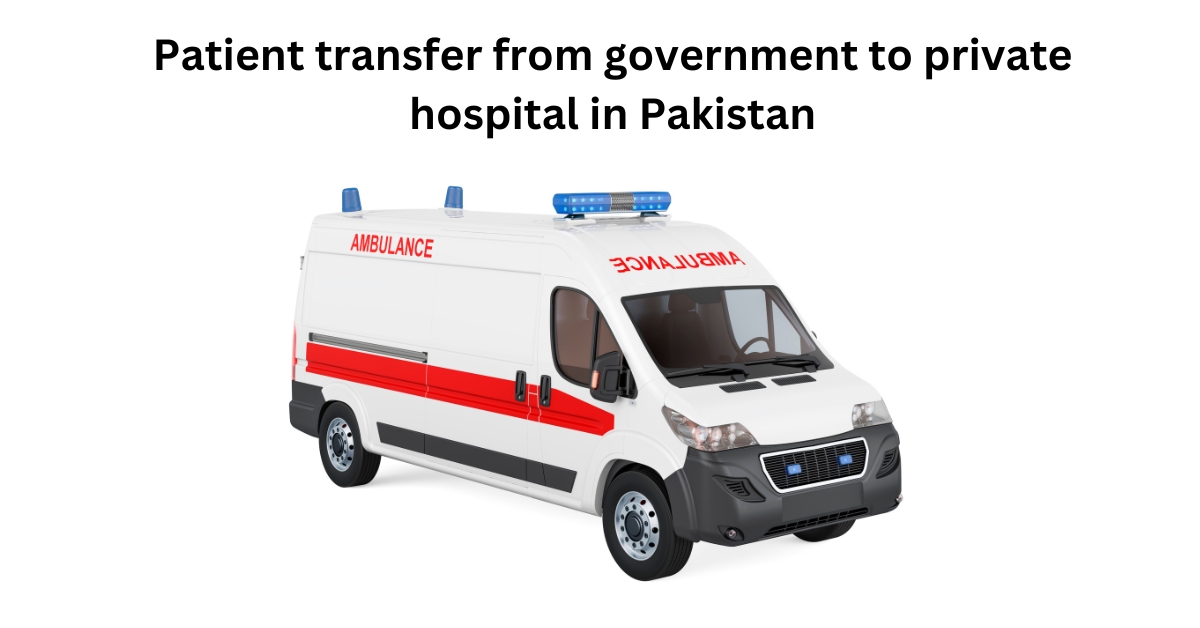
Patient Transfer from Government to Private Hospital in Pakistan — Complete Guide
In Pakistan, patients are often transferred from government hospitals to private facilities for specialized care, shorter waiting times, or better amenities[reference:0]. While public hospitals like PIMS, Jinnah Hospital, or Mayo Hospital provide excellent emergency and trauma care, they may lack immediate access to certain specialists, advanced diagnostics, or private rooms for long-term recovery. This is where a safe, well-coordinated patient transfer becomes essential.
However, moving a patient — especially one who is critically ill or on a ventilator — is not as simple as calling a cab. It requires medical clearance, proper documentation, and an ambulance equipped with the right life-support systems. Unfortunately, hospital transfers in Pakistan remain one of the most poorly coordinated aspects of the healthcare system, with families often left to arrange referrals, search for beds, and transport patients with little assistance from the treating hospital[reference:1].
This guide is designed to change that. Whether you are transferring a stable patient for elective surgery or a critical case requiring intensive monitoring, we walk you through every step — from getting a referral and gathering documents to choosing the right ambulance and understanding costs. Insaf Ambulance Services provides professional, ICU-equipped ambulances for inter-hospital transfers at transparent rates: 80 PKR/km for BLS, 100 PKR/km for ALS, and 120 PKR/km for ICU ambulances, with a special flat rate of 80 PKR/km for distances exceeding 300 km[reference:2]. Call +92 3298041122 for 24/7 assistance.
📞 Call +92 3298041122 💬 WhatsApp Us
🏥 Why Transfer from Government to Private Hospital?
Families opt for private hospital transfers for several reasons:
- ✔ Specialized Consultants: Quicker access to cardiologists, neurosurgeons, or orthopedic specialists[reference:3].
- ✔ Private Rooms & Comfort: Better environment for long-term recovery or palliative care[reference:4].
- ✔ Advanced Diagnostics: Same-day MRI, CT, or PET-CT scans with shorter wait times[reference:5].
- ✔ Elective Surgeries: Scheduled procedures often done at private institutions[reference:6].
- ✔ Second Opinion: Families seeking additional medical opinions may need to transfer[reference:7].
⚠️ Challenges Families Face During Hospital Transfer
Pakistan's healthcare system lacks a uniformly implemented mechanism for inter-hospital transfers[reference:9]. Families commonly encounter:
- ✖ No Active Coordination: Referring hospitals often do not coordinate with receiving facilities or help confirm bed availability[reference:10].
- ✖ Documentation Delays: Many hospitals refuse to provide a concise clinical summary while treatment is ongoing, even when families wish to seek a second opinion[reference:11]. Some insist on issuing discharge summaries only after formal discharge or against-medical-advice (LAMA) documentation[reference:12].
- ✖ Families Left Alone: Attendants must personally contact hospitals across the city to check for ICU, NICU, or HDU bed availability because the referring hospital does not facilitate the process[reference:13].
- ✖ No Standardized Transfer Summary: Internationally, inter-facility transfers use structured referral systems with standardized documentation[reference:14]. In Pakistan, this is often missing[reference:15].
These delays can have serious consequences in emergency medicine, where treatment decisions depend on rapid communication between healthcare providers[reference:16]. A standard transfer summary should include the working diagnosis, current clinical condition, investigations, medications, and reason for referral[reference:17].
📝 Step-by-Step Patient Transfer Process
Follow these steps to ensure a smooth transfer from a government to a private hospital:
Get a written discharge/transfer summary from the attending physician at the government hospital[reference:18]. This document must include the diagnosis, current condition, treatment given, and reason for transfer[reference:19].
Contact the private hospital's admissions or emergency department. Confirm bed availability (ICU, HDU, or general ward) and ensure they accept the patient based on the referral summary.
Collect the transfer summary, medical records, investigation reports, medication list, and a copy of the patient's CNIC. Keep both originals and copies.
Call +92 3298041122 to book an Insaf Ambulance. Provide pickup location (government hospital, ward number), destination (private hospital), and patient condition so we send the right ambulance type[reference:20].
Inform the private hospital of your estimated arrival time. Ensure the government hospital has the patient ready for handover. Our paramedics will assist with the transfer and share critical information with the receiving team.
Our ambulance transports the patient safely with continuous monitoring. Upon arrival, we help with handover to the private hospital's medical team.
📋 Essential Documents for Patient Transfer
Having the right documents ready can prevent delays. Here's what you need:
| Document | Purpose |
|---|---|
| Discharge/Transfer Summary | Contains diagnosis, treatment, and reason for transfer[reference:21] |
| Medical Records & Investigation Reports | Helps receiving hospital continue care without重复 tests[reference:22] |
| Medication List | Ensures continuity of prescribed drugs |
| Patient CNIC Copy | Required for hospital admission and insurance |
| Insurance Card / Policy Details | If claiming ambulance or treatment costs from insurance |
| NOK/Attendant CNIC | For identity verification and consent |
🚑 Ambulance Types for Hospital Transfer — Choose the Right One
Choosing the right ambulance depends on the patient's stability and medical needs[reference:25]. Insaf Ambulance offers three categories:
| Ambulance Type | Best For | Key Equipment | Rate (PKR/km) |
|---|---|---|---|
| BLS | Stable patients, wheelchair or stretcher, non-critical[reference:26] | Stretcher, oxygen, first aid, AC, basic monitoring[reference:27] | 80 PKR |
| ALS | Patients needing ECG monitoring, IV drips, paramedic supervision[reference:28] | ECG monitor, defibrillator, oxygen, suction, emergency drugs[reference:29] | 100 PKR |
| ICU | Ventilator-dependent, critical but stable, cardiac or respiratory failure[reference:30] | Portable ventilator, infusion pumps, multi-parameter monitor, critical care nurse[reference:31] | 120 PKR |
Important: For transfers from ICU or high-dependency units, always request an ICU ambulance with a ventilator and critical care nurse[reference:32].
💰 Transparent Pricing for Patient Transfer Ambulance
Insaf Ambulance offers clear, per-kilometer pricing with no hidden charges. Here's a breakdown:
| Distance | Ambulance Type | Rate (PKR/km) | Example Cost |
|---|---|---|---|
| Local (within city) | BLS | 80 | 10 km → 800 PKR |
| Local (within city) | ICU | 120 | 10 km → 1,200 PKR |
| Inter-city (≤300 km) | ICU | 120 | Lahore to Islamabad (280 km) → 33,600 PKR |
| Inter-city (>300 km) | Any Type | 80 PKR/km flat | Lahore to Karachi (1,200 km) → 96,000 PKR[reference:33] |
✔ Special Discount: For any journey exceeding 300 km, the rate drops to 80 PKR/km for all ambulance types — making long-distance patient transfers significantly more economical[reference:34].
✔ Insurance Coverage: Many health insurance policies in Pakistan provide coverage for ambulance services, particularly for emergency transfers and medically necessary inter-facility transports[reference:35]. Insaf Ambulance provides detailed invoices to support your claim.
💡 Pro Tips for a Smooth Patient Transfer
- ✔ Start Early: Begin the process as soon as the decision to transfer is made. Delays can affect patient outcomes.
- ✔ Communicate Clearly: Inform both hospitals about the transfer. Share the patient's condition and estimated arrival time.
- ✔ Keep Documents Ready: Have all medical records, CNIC copies, and insurance details in a single folder.
- ✔ Choose the Right Ambulance: For critical patients, never compromise on an ICU ambulance with a ventilator and trained paramedic.
- ✔ Stay with the Patient: If possible, have a family member accompany the patient to provide comfort and assist with handover.
- ✔ Check Insurance Coverage: Contact your insurer in advance to understand ambulance coverage limits and claim procedures.
📞 Call +92 3298041122 📱 WhatsApp +92 3298041122 ➡️ Contact us for advance booking or emergency transfer