


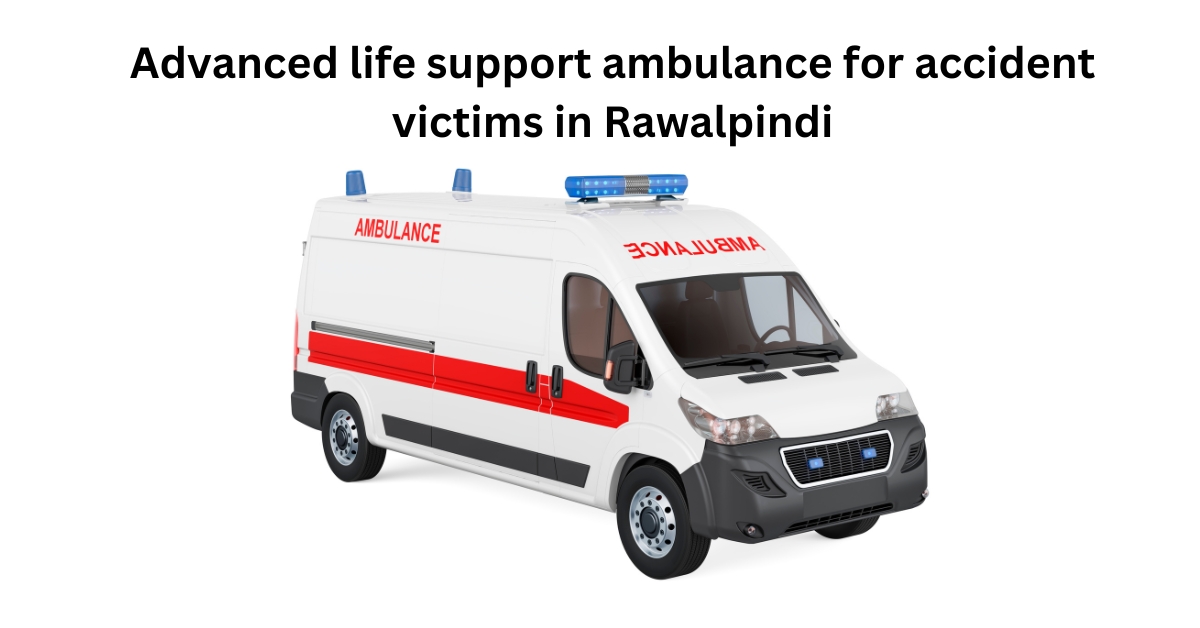
🚑 Advanced Life Support Ambulance for Accident Victims in Rawalpindi
📖 Table of Contents
- 1. Why Accident Victims Need ALS Ambulances
- 2. Rawalpindi Accident Statistics (2024–2025)
- 3. What Is an Advanced Life Support Ambulance?
- 4. ALS Equipment & Life-Saving Tech
- 5. The Golden Hour — Why Speed Matters
- 6. Insaf Ambulance — ALS Services in Rawalpindi
- 7. Transparent Pricing — 80–120 PKR/km
- 8. Service Areas & Coverage
- 9. ALS vs. BLS — Comparison Table
- 10. Frequently Asked Questions (FAQs)
1. Why Accident Victims Need ALS Ambulances
Road accidents are unpredictable and often result in life-threatening injuries such as traumatic brain injury, internal bleeding, cardiac arrest, or respiratory failure. A Basic Life Support (BLS) ambulance can provide oxygen and first aid, but Advanced Life Support (ALS) goes much further.
An ALS ambulance is essentially a mobile emergency room. It carries defibrillators, cardiac monitors, ventilators, suction units, and advanced medications — and is staffed by paramedics trained in Advanced Cardiac Life Support (ACLS)[reference:1][reference:2]. For an accident victim with a collapsed lung, severe bleeding, or cardiac arrhythmia, ALS intervention starts the moment the ambulance arrives, not when the hospital is reached.
In Rawalpindi, where traffic congestion and narrow streets are common[reference:3], having an ALS ambulance with GPS tracking and trained ICU staff can dramatically improve survival odds[reference:4].
2. Rawalpindi Accident Statistics (2024–2025)
The numbers are stark. According to Rescue 1122 data:
- 2025: 16,626 road accidents → 199 deaths, 18,633 injured (8,472 seriously)[reference:5][reference:6]
- 2024: 17,520 accidents → 190 deaths, 17,658 injured[reference:7]
- Most affected: males (15,661) and age group 11–40 years[reference:8]
- Main causes: overspeeding, careless driving, one-wheeling[reference:9]
These figures highlight the critical need for advanced pre-hospital care. Every year, thousands of accident victims in Rawalpindi require immediate ALS-level interventions to prevent death or permanent disability.
3. What Is an Advanced Life Support Ambulance?
An ALS ambulance is a fully equipped medical vehicle designed for critical emergencies. Unlike BLS ambulances, which are suited for stable patients, ALS units provide:
- ✔ Continuous cardiac monitoring with defibrillation capability
- ✔ Mechanical ventilators for patients who cannot breathe independently
- ✔ IV access and advanced medications (e.g., epinephrine, amiodarone)
- ✔ ACLS-certified paramedics and ICU-trained staff[reference:11]
- ✔ Suction, airway management tools, and trauma kits[reference:12]
For accident victims with multi-system trauma, an ALS ambulance can stabilize the patient en route to hospitals like Benazir Bhutto Hospital, DHQ Hospital, or Ali Medical Center[reference:13].
4. ALS Equipment & Life-Saving Tech
Insaf Ambulance ALS units are equipped with hospital-grade technology that rivals an ICU[reference:14]:
| Equipment | Function | Critical for accident victims |
|---|---|---|
| ECG / Cardiac Monitor | Continuous heart rhythm tracking | Detects arrhythmias from chest trauma |
| Defibrillator | Delivers shocks to restore normal rhythm | Cardiac arrest after severe impact |
| Portable Ventilator | Mechanical breathing support | Respiratory failure, head injury[reference:15] |
| Infusion Pumps | Precise medication/IV delivery | Hemorrhage control, pain management |
| Suction Unit | Clears airways of blood/vomit | Prevents aspiration in unconscious patients |
| Spine Board & Cervical Collars | Immobilization | Prevents spinal cord damage[reference:16] |
5. The Golden Hour — Why Speed Matters
The "golden hour" is the critical 60‑minute window after traumatic injury during which definitive medical care dramatically improves survival[reference:17]. For every minute of delay, the chance of survival decreases.
In Rawalpindi, traffic congestion and distance from major trauma centers can extend response times. That's why Insaf Ambulance uses GPS tracking and strategically positioned units to achieve average response times under 8 minutes in urban areas[reference:18]. Their ALS ambulances are dispatched immediately, and life-saving care begins at the accident scene — not when the patient reaches the ER.
6. Insaf Ambulance — ALS Services in Rawalpindi
Insaf Ambulance Services is a trusted name in Rawalpindi and Islamabad, providing 24/7 emergency and ICU-level transport[reference:19]. For accident victims, they offer:
- ✔ Free ambulance service for accident victims and unclaimed bodies[reference:20]
- ✔ ALS ambulances with ventilators, defibrillators, and ACLS paramedics[reference:21]
- ✔ ICU ventilator ambulances for the most critical trauma cases[reference:22]
- ✔ Coordination with major hospitals: Benazir Bhutto, DHQ, PIMS, CMH[reference:23]
- ✔ Multilingual staff (Urdu, Punjabi, English) for clear communication[reference:24]
Their fleet includes BLS, ALS, AC, and full ICU ventilator ambulances, ensuring the right level of care for every situation[reference:25].
7. Transparent Pricing — 80–120 PKR/km
Insaf Ambulance believes in honest, upfront pricing with no hidden charges[reference:26]. The rate depends on the ambulance type:
| Ambulance Type | Rate (PKR/km) | Best for |
|---|---|---|
| Basic Life Support (BLS) | 80 | Stable patients, hospital transfers |
| Advanced Life Support (ALS) | 100 | Accident victims, cardiac emergencies, trauma |
| AC Ambulance | 100–110 | Comfortable non-emergency transport |
| ICU Ventilator Ambulance | 120 | Critical patients, respiratory failure[reference:27] |
🔥 Special long‑distance rule: For any journey exceeding 300 km, the rate is flat 80 PKR/km for all ambulance types[reference:28]. This makes inter‑city transfers (e.g., Rawalpindi to Lahore, Karachi, or Peshawar) much more affordable.
8. Service Areas & Coverage
Insaf Ambulance covers the entire Rawalpindi district and Islamabad, including:
- Rawalpindi: Saddar, Cantt, Commercial Market, Raja Bazaar, Satellite Town, Bahria Town, DHA[reference:29][reference:30]
- Islamabad: F‑sectors, G‑sectors, Blue Area, Diplomatic Enclave[reference:31]
- Key hospitals: Benazir Bhutto, DHQ, PIMS, CMH, Ali Medical Center[reference:32]
Their GPS‑enabled dispatch ensures the nearest ALS unit reaches you quickly, even in congested areas[reference:33].
9. ALS vs. BLS — Comparison Table
| Feature | BLS Ambulance | ALS Ambulance |
|---|---|---|
| Staff | EMT (Basic) | ACLS Paramedic / ICU nurse |
| Cardiac monitoring | ❌ No | ✅ Yes (ECG + defib) |
| Ventilator | ❌ No | ✅ Portable ventilator |
| Advanced medications | ❌ No | ✅ IV drugs, ACLS protocol |
| Spinal immobilization | ✅ Basic | ✅ Advanced with traction |
| Ideal for | Stable transfers | Trauma, cardiac arrest, respiratory failure |
For accident victims, an ALS ambulance is non‑negotiable — it provides the life‑sustaining interventions needed before reaching the trauma center.
❓ Frequently Asked Questions (FAQs)
Drowning First Aid in Pakistan | Ambulance in Wah Cantt & Taxila | Discharge Ambulance from Benazir RWP | Emergency Medical Care