


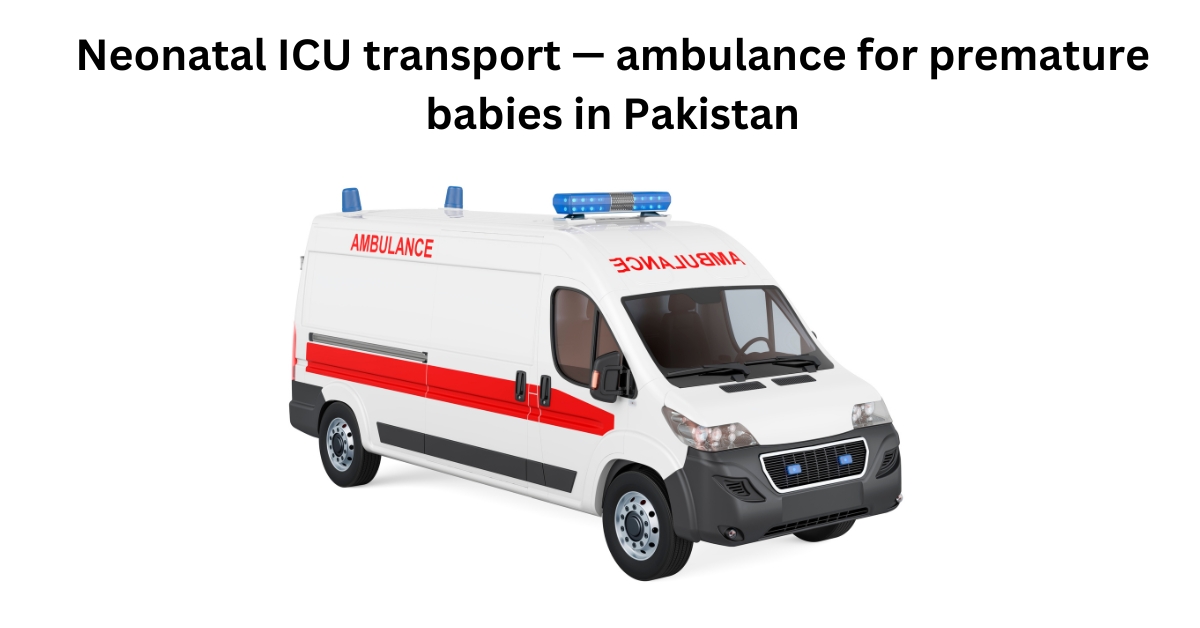
Neonatal ICU Transport —
Ambulance for Premature Babies in Pakistan
Transporting a premature or critically ill newborn between hospitals in Pakistan is one of the most clinically delicate transport events in medicine. Temperature instability, oxygen dependency, fragile airways, and tiny IV access mean that the wrong ambulance — or any delay — can have irreversible consequences. This guide covers everything parents and doctors need to know.
Urgent NICU transfer needed for a newborn?
Call Insaf Ambulance immediately: +92 3298041122 — state "neonatal transfer" and receiving NICU name. We prepare before arrival. Available 24/7.
- Why Neonatal Transport Is Different from Adult ICU Transfer
- When Does a Premature Baby Need Ambulance Transfer?
- Neonatal Transport Equipment — What Must Be Onboard
- NICU Pre-Transfer Checklist — Doctors & Families
- Managing the Neonatal Patient During the Journey
- Major NICU Hospitals in Pakistan — Transfer Destinations
- Neonatal Transport Fares 2026 — Local & Inter-City
- Family Guidance — What Parents Should Know
- Frequently Asked Questions
- Related Articles
1. Why Neonatal Transport Is Different from Adult ICU Transfer
Premature and critically ill neonates present a unique set of transport challenges that are qualitatively different from those of adult ICU patients. The physiological differences are not merely a matter of scale — a newborn's regulatory systems are fundamentally immature, meaning that variables the adult body manages automatically (temperature, blood glucose, oxygen saturation, acid-base balance) must be actively maintained by external equipment and clinical intervention throughout every minute of transport.
Temperature regulation is the most critical and most commonly underestimated challenge. A premature neonate can lose body heat at a rate that rapidly causes hypothermia in an ambient environment of 20–22°C — conditions that feel comfortable to the adults in the room but are dangerously cold for a 1.2 kg infant with minimal subcutaneous fat. Hypothermia in a neonate is not just a discomfort — it increases oxygen consumption, worsens respiratory distress, causes hypoglycaemia, and can trigger bradycardia. The transport vehicle must maintain a warm, controlled microenvironment around the baby at all times.
Oxygen dependency is equally critical. Premature babies with respiratory distress syndrome, transient tachypnoea of the newborn, or other pulmonary conditions require precisely calibrated oxygen delivery — too little causes hypoxia, too much causes retinopathy of prematurity (ROP) and lung injury. Neonatal oxygen delivery requires blended O₂/air systems, not the high-flow 100% oxygen appropriate for adult emergencies. IV access in neonates is typically through umbilical catheters or peripheral neonatal lines — lines that are extremely small, fragile, and critically important for glucose infusions that prevent hypoglycaemia during the journey.
👶 Neonatal or Premature Baby Transfer Needed? Call Now.
Insaf Ambulance Services provides temperature-controlled, neonatal-configured transport for premature and critically ill newborns across Pakistan. Tell us the baby's gestational age, weight, and current support needs — we prepare before arrival.
2. When Does a Premature Baby Need Ambulance Transfer?
Neonatal ambulance transfers in Pakistan occur in several distinct clinical scenarios — each with different urgency and equipment requirements:
District Hospital → Tertiary NICU
Baby born in district hospital without NICU capability. Transfer needed to Shifa, PIMS, NICH, or Children's Hospital for specialist neonatal care. Most common neonatal transfer type in Pakistan.
NICU-to-NICU Specialist Transfer
Baby in NICU requires specialist care not available at current facility — cardiac surgery, neurosurgery, or subspecialty neonatal intervention at a higher-level centre.
Home Birth / Community Delivery → Hospital
Premature or distressed baby born at home or community setting. Requires urgent temperature stabilisation and IV access during transport to nearest NICU.
Congenital Heart Disease — Pre-Surgical Transfer
Neonate with detected cardiac defect requiring transfer to cardiac surgical centre. Prostaglandin infusion may be running — infusion pump continuity critical during transport.
Post-NICU Discharge — Step-Down Transfer
Stable premature baby being discharged from NICU to a step-down facility or transitional care unit closer to the family's home city.
Neonatal Seizures / HIE Transfer
Hypoxic-ischaemic encephalopathy or neonatal seizures requiring cooling therapy (therapeutic hypothermia) — time-critical transfer to cooling-capable NICU within 6 hours of birth.
3. Neonatal Transport Equipment — What Must Be Onboard
The equipment requirements for safe neonatal transport are distinct from adult ICU transport. Here is what Insaf Ambulance's neonatal-configured transport provides:
👶 Neonatal Transport Equipment Configuration — Insaf Ambulance
| Equipment | Why It Matters for Neonates | Risk Without It |
|---|---|---|
| Temperature-controlled cabin | Prevents hypothermia (core temp drop below 36.5°C) | Hypothermia → bradycardia, hypoglycaemia, apnoea |
| Blended O₂/air system | Delivers precise FiO₂ — avoids 100% O₂ toxicity | Hyperoxia → retinopathy of prematurity, lung injury |
| Neonatal infusion pump | Maintains glucose at µl/hr — prevents hypoglycaemia | Hypoglycaemia → brain injury in minutes |
| Pre-ductal SpO₂ probe | Right hand probe shows true cerebral O₂ delivery | Post-ductal reading may miss ductal shunting |
| Neonatal bag-valve mask | Correct mask size creates seal without eye pressure | Wrong-size mask = inadequate ventilation |
| Continuous temperature monitor | Alerts crew before temp drops to dangerous level | Silent hypothermia undetected until crisis |
4. NICU Pre-Transfer Checklist — Doctors & Families
Safe neonatal transport begins before the ambulance arrives. The sending NICU team and the family both have responsibilities in the preparation window:
✅ NICU Medical Team — Pre-Transfer Preparation
- Baby's temperature stable at 36.5–37.5°C before loading
- Blood glucose checked — at least 2.6 mmol/L (47 mg/dL) confirmed
- IV access confirmed patent — all lines flushed and secured with tape
- Current FiO₂ requirement, respiratory support mode (CPAP, HFNC, intubated)
- Prostaglandin or other critical infusions running on battery-backed syringe pump
- Gestational age, birth weight, and current weight documented
- Receiving NICU confirmed with cot/incubator available
- Written transport summary including all medications and doses
- Consent signed by parent / guardian
⚠️ Danger Signs — Do NOT Transfer Until Stabilised
- Temperature below 36.0°C — warm first, then transport
- FiO₂ requirement above 0.7 and rising — not stable for transport
- Blood glucose below 2.6 mmol/L — treat before departure
- Active seizures not yet controlled
- IV access lost — do not transport without patent access
- Receiving NICU bed not yet confirmed
- Baby in active resuscitation — stabilise first
Family Preparation Before Neonatal Transfer
- One parent travels in ambulance — designated decision-maker, CNIC ready
- Full NICU documentation folder: birth record, blood group, lab results, imaging, drug chart
- Receiving hospital's NICU address, unit name, and direct contact number
- Arrange for other children/family if both parents cannot travel
- Insurance documents if applicable — see our guide on insurance covering ambulance costs
5. Managing the Neonatal Patient During the Journey
What happens from the moment the baby is loaded until NICU handover at the receiving hospital:
Pre-Departure Equipment Verification
Cabin temperature confirmed at 35–37°C. SpO₂ probe (right hand) attached and reading. Infusion pump battery at 100%. O₂ cylinder pressure checked sufficient for journey plus 50% margin. Temperature blanket/wrap applied.
Transfer from NICU Incubator to Transport Setup
Baby transferred from bedside incubator to warm transport wrap with minimal exposure time. All IV lines and tubes checked and secured. SpO₂ and temperature monitor readings confirmed stable. Receiving NICU pre-alert sent.
Monitoring Cycle During Journey
Temperature, SpO₂, heart rate, respiratory rate, and colour documented every 10 minutes. Blood glucose checked if journey exceeds 60 minutes. Infusion pump rates verified unchanged. Crew alerts driver to slow down if SpO₂ dips or apnoea occurs (smooth ride essential).
Response to Deterioration En Route
Apnoea: gentle tactile stimulation → bag-mask ventilation if unresponsive. SpO₂ drop: increase FiO₂ incrementally, check mask position. Temp drop: additional wrap, increase cabin temp. Bradycardia (<100): bag-mask ventilation, check glucose, neonatal cardiac arrest protocol if <60 bpm. Pull over vehicle for hands-on resuscitation.
NICU Handover — Structured SBAR
Gestational age, birth weight, reason for transfer, events during journey, current FiO₂ and respiratory support, infusion rates, temperature, glucose. All documentation transferred. Parent introduced to receiving NICU team.
6. Major NICU Hospitals in Pakistan — Transfer Destinations
Insaf Ambulance Services transfers neonates to the following major NICU facilities across Pakistan:
Shifa International Hospital NICU
Largest private NICU in Islamabad. Level III NICU. Ventilator-capable, CPAP, cooling therapy. Accepts neonatal transfers from Rawalpindi and beyond.
PIMS Children's Ward NICU
Government tertiary NICU. Free services. Accepts high-risk referrals from across CDA zones and referring districts.
Children's Hospital Lahore
Pakistan's largest paediatric government hospital. Advanced NICU. Major destination for cardiac, neuro, and surgical neonatal referrals from across Punjab.
NICH — National Institute of Child Health
Premier government paediatric hospital in Sindh. NICU, cardiac surgery, paediatric subspecialties. Primary referral destination for southern Pakistan neonates.
Shaukat Khanum Paediatric Unit
Specialist oncology and paediatric complex care. For neonates with complex malignancy presentations or specialist neonatal surgical needs.
Holy Family Hospital NICU
Government tertiary hospital — Rawalpindi's primary government NICU. Accepts district referrals from Attock, Chakwal, Jhelum, and surrounding regions.
7. Neonatal Transport Fares 2026 — Local & Inter-City
Insaf Ambulance's neonatal transport uses the AC ambulance or ICU unit depending on clinical needs. Fares follow the standard published rate — no neonatal premium:
🧮 Neonatal Transport Fare Estimates 2026
| Ambulance Type | Rate ≤300 km | Rate >300 km | Neonatal Suitability |
|---|---|---|---|
| AC Ambulance | 100–110 PKR/km | 80 PKR/km flat | ✔ Stable premature baby, step-down transfer |
| ICU / Ventilator Unit | 120 PKR/km | 80 PKR/km flat | ✔ Ventilated neonate, prostaglandin infusion, HIE |
| ALS Advanced | 100 PKR/km | 80 PKR/km flat | Partial — no incubator, suitable for short stable transfers |
| BLS Basic | 80 PKR/km | 80 PKR/km flat | ✘ Not suitable for sick or premature neonates |
8. Family Guidance — What Parents Should Know
Parents facing a neonatal transfer are in one of the most frightening situations a family can experience. Here is practical guidance to help navigate it:
💜 Emotional & Practical Support
- Ask the NICU team: "Is my baby stable enough for transfer?" — understand the decision
- One parent travels in ambulance; the other travels separately or in family vehicle
- Receive the neonatologist's direct number at the receiving NICU before departure
- Document the ambulance number and Insaf Ambulance contact — +92 3298041122 — for family to track
- It is normal to feel frightened — the crew is trained for this and will keep you informed throughout
✅ Information to Give Insaf Ambulance at Booking
- Baby's gestational age (e.g., 30 weeks) and current age in days
- Current weight (e.g., 1.2 kg)
- Respiratory support: breathing room air / nasal cannula / CPAP / intubated
- Current FiO₂ requirement (e.g., 0.3 = 30% oxygen)
- Active IV infusions and what is running
- Sending hospital name and NICU location (floor/ward)
- Receiving hospital name and NICU contact
- Estimated departure time window
9. Frequently Asked Questions
👶 Every Minute Matters for a Premature Baby — Call Now.
Insaf Ambulance Services provides Pakistan's most carefully configured neonatal transport — temperature-controlled, neonatal-equipment-fitted, and staffed by crews briefed on neonatal physiology. Local transfers from 80 PKR/km. Long-distance flat rate 80 PKR/km over 300 km — all ambulance types. Available 24/7. Tell us the baby's gestational age and current support needs — we prepare before arrival.
10. Related Articles & Service Guides
How Pakistani health insurance and takaful plans can offset neonatal transport costs.
How GPS dispatch ensures the fastest neonatal transport unit is dispatched every time.
Local ambulance guide for Islamabad's highest-density residential sectors.
Step-by-step guide for transferring NICU patients from government to private facilities.