


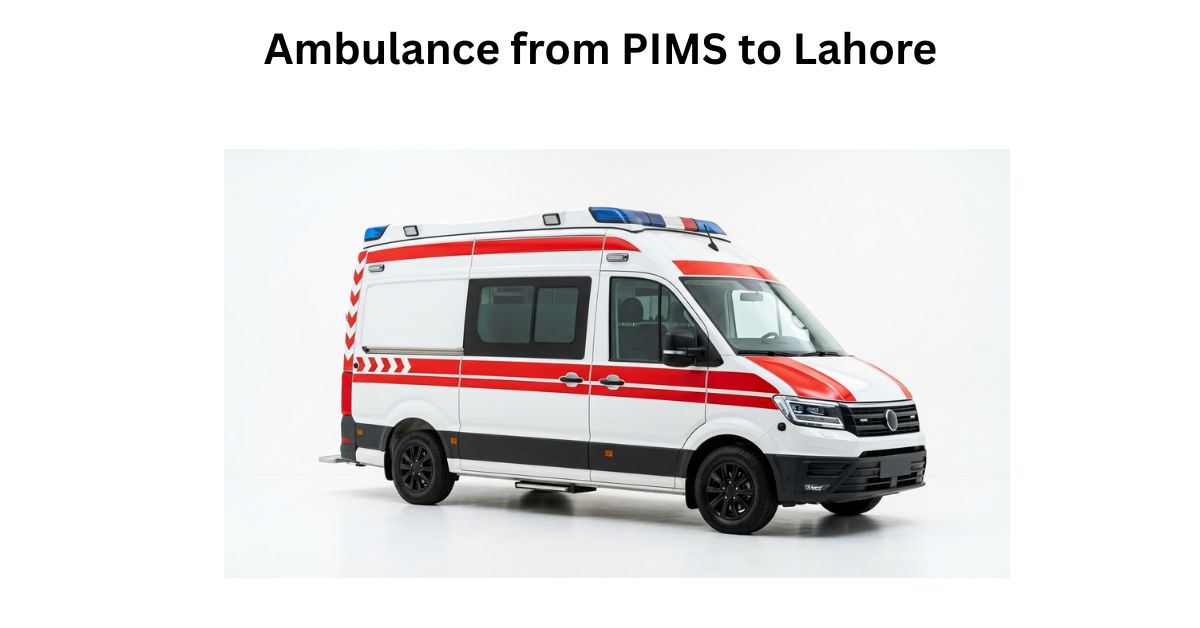
Ambulance from PIMS to Lahore: Fare, Route, and What to Pack
📋 Table of Contents
- Why Patients Transfer from PIMS to Lahore
- Route, Distance & Travel Time
- Ambulance Fare Table (2027 Rates)
- Which Ambulance Do You Need?
- What to Pack for the Journey
- Documents Required for Transfer
- What Happens During the Journey
- Lahore Hospitals We Transfer To
- How to Book – Step by Step
- FAQs – PIMS to Lahore Ambulance
- Related Articles & Services
Pakistan Institute of Medical Sciences (PIMS) in Islamabad is one of the country's largest public hospitals, serving patients from across the northern region. But sometimes a patient at PIMS needs specialized treatment available only in Lahore — at Shaukat Khanum, Punjab Institute of Cardiology, Jinnah Hospital, or a specialized private facility. When that happens, families face a challenging task: arranging a safe, medically supervised transfer across 380 kilometers of motorway.
The journey from PIMS to Lahore takes 4.5–5 hours of continuous driving. For a stable patient, this is manageable with a BLS ambulance. For a critically ill patient on a ventilator, receiving vasoactive medications, or recovering from surgery, an ICU ambulance with a ventilator, cardiac monitor, infusion pumps, and critical care staff is essential.
This guide is written specifically for families facing this situation. It answers the most important questions: What does an ambulance from PIMS to Lahore cost in 2027? What route does it take? What should we pack? What documentation is required? And how do we prepare a critically ill patient for a 5-hour journey?
🏥 Why Patients Transfer from PIMS to Lahore
PIMS is a major tertiary care hospital, but certain highly specialized treatments are only available at Lahore's leading medical centers. Families choose transfer for several reasons:
- 🎗️ Oncology: Shaukat Khanum Memorial Cancer Hospital — advanced cancer treatment, radiation, surgery
- ❤️ Cardiac surgery: Punjab Institute of Cardiology (PIC) — complex bypass, valve replacement, pediatric cardiac surgery
- 🧠 Neurosurgery: Specialized brain and spine procedures at Jinnah, Mayo, or private facilities
- 🫘 Organ transplant: Kidney, liver, and bone marrow transplant programs
- 👶 Neonatal & pediatric ICU: Children's Hospital Lahore offers specialized NICU/PICU
- 🩸 Rare disease management: Conditions not treated at PIMS
- 🏥 Family preference: Many families prefer Lahore hospitals or have relatives there
- 💰 Insurance coverage: Some insurance plans empanel only Lahore hospitals
- 🩺 Second opinion: Consultation at Lahore's specialist centers
- 🚑 Bed availability: When PIMS lacks a bed for a specific specialty
🛣️ Route, Distance & Travel Time
The journey from PIMS Islamabad to Lahore covers approximately 380 km, primarily via the M-2 Motorway. This is one of Pakistan's best-maintained and safest motorway routes.
🚑 Primary Route: PIMS → Lahore
PIMS Hospital → Islamabad Expressway → M-2 Motorway (Islamabad–Lahore) → Lahore Ring Road / Thokar Niaz Baig → Lahore city → destination hospital
Total Distance: ~380 km
Total Travel Time: 4.5–5 hours (non-stop, with driver relief if needed)
Major Stops En Route: Rawalpindi, Chakwal Interchange, Sialkot Interchange, Bhalwal, Sheikhupura
| Segment | Distance | Approx. Time | Key Points |
|---|---|---|---|
| PIMS → Islamabad Expressway | ~10 km | 15–20 min | City traffic, hospital exit |
| Expressway → M-2 entry | ~15 km | 20–25 min | Rawalpindi ring road |
| M-2 (Islamabad to Lahore) | ~340 km | 3.5–4 hrs | Motorway, service areas |
| Lahore Ring Road → Hospital | ~15 km | 20–30 min | Depends on destination |
💡 Note: For critical patients, the journey may take longer due to required medical stops, oxygen replenishment, or stabilization breaks. Our team plans these carefully. Peak traffic in Lahore at arrival can add 20–30 minutes.
Motorway Service Areas Along M-2
- ⛽ Chakwal Service Area: Fuel, food, washrooms (~110 km from Islamabad)
- ⛽ Sialkot Interchange Service Area: Fuel, food, washrooms (~200 km)
- ⛽ Bhalwal Service Area: Fuel, food, washrooms (~280 km)
- ⛽ Sheikhupura Service Area: Fuel, food, washrooms (~340 km)
- 🚑 Motorway Police Stations: At each service area, coordination with 130
💰 Ambulance Fare PIMS to Lahore (2027 Rates)
Costs depend on ambulance type, staffing, equipment, and any special requirements. Below are indicative fares for 2027.
| Ambulance Type | Estimated Fare (PKR) | Includes | Best For |
|---|---|---|---|
| Patient Transport | PKR 25,000 – 40,000 | Stretcher, basic oxygen, attendant, driver, fuel, tolls | Stable patients not requiring monitoring |
| BLS Ambulance | PKR 30,000 – 45,000 | Oxygen, stretcher, first aid, suction, EMT, driver | Stable patients needing basic monitoring |
| Oxygen Ambulance | PKR 35,000 – 55,000 | High-flow oxygen, masks, nebulizer, oximeter, EMT | Respiratory patients, low SpO₂ |
| ALS Ambulance | PKR 45,000 – 70,000 | Cardiac monitor, defibrillator, IV drugs, paramedic | Cardiac emergencies, high-risk transfers |
| ICU Ambulance | PKR 70,000 – 1,20,000 | Ventilator, multi-param monitor, infusion pumps, critical care nurse/paramedic | Ventilated, critical, post-surgery patients |
| ICU with Doctor | PKR 1,00,000 – 1,50,000 | All above + critical care doctor onboard | Most critical patients needing physician oversight |
| Neonatal ICU | PKR 80,000 – 1,30,000 | Incubator, neonatal ventilator, neonatal nurse | Premature or critically ill newborns |
💰 Fare Comparison: PIMS to Lahore (PKR)
*Indicative mid-point fares for 2027. Actual prices vary by provider and specific requirements.
What's included in the fare:
- 🚑 Ambulance, driver, fuel, and M-2 toll charges
- 🧑⚕️ Medical staff (EMT, paramedic, nurse, or doctor depending on type)
- 🫁 Oxygen and consumables used during transport
- 📈 Equipment usage (ventilator, monitor, infusion pumps)
- 📞 Coordination with both PIMS and the receiving Lahore hospital
- 📋 Medical documentation during transport
Additional charges that may apply:
- ⏳ Waiting time: If the ambulance waits at PIMS before departure
- 💊 Specialty medications: Vasopressors, sedatives used during transport
- 🫁 Additional oxygen: For extended journeys or high-flow requirements
- 🔄 Return journey: If the ambulance returns empty to Islamabad
- 🌙 Night surcharge: Some providers charge extra for late-night departures
🚨 Which Ambulance Do You Need for PIMS to Lahore?
Not every patient requires the same level of care. The choice depends entirely on the patient's condition.
| Ambulance Type | Equipment | Staff | Best For |
|---|---|---|---|
| ICU Ambulance (Ventilator) | Ventilator, multi-param monitor, defibrillator, infusion pumps, suction, oxygen | Critical care doctor/nurse + paramedic + driver | Ventilated patients, unstable cardiac, severe trauma, post-surgery |
| ALS Ambulance | Cardiac monitor, defibrillator, oxygen, IV drugs, suction | Paramedic + driver | Stable but high-risk patients, cardiac monitoring needed |
| Oxygen Ambulance | High-flow oxygen, masks, nebulizer, oximeter | EMT/Paramedic + driver | Respiratory patients, low SpO₂ |
| BLS Ambulance | Oxygen, stretcher, first aid, immobilization | EMT + driver | Stable patients not requiring intensive monitoring |
| Patient Transport | Stretcher, wheelchair, basic oxygen | Driver + attendant | Stable, mobile patients |
For a PIMS-to-Lahore transfer, most critical patients require an ICU ambulance with a ventilator. The journey is long, and the patient's condition may change en route.
For a detailed explanation of ICU ambulance equipment and staffing, see our guide on ICU ambulance service.
🎒 What to Pack for the Journey
Proper packing ensures the patient's comfort and safety during the 4.5–5 hour journey. Here's a complete checklist.
Patient Essentials
👤 Patient Items
- Comfortable, loose clothing (if changing is possible)
- Warm shawl or light blanket (for the journey)
- Slippers or easy-to-wear footwear
- Extra pair of socks (for warmth)
- Prescription glasses (if applicable)
- Hearing aid and batteries (if applicable)
- Denture case (if applicable)
- Adult diapers or sanitary items (if needed)
- Wet wipes and tissues
- Emesis bag (in case of nausea/vomiting)
- Water bottle with straw (if the patient can drink)
- Light snack (if doctor permits)
Medical Items
💊 Medical Essentials
- All current medications (extra supply — at least 3 days)
- Prescription slips for all medications
- Recent medical reports and discharge summary
- All imaging films (CT, MRI, X-rays)
- Lab reports and blood test results
- PIMS patient card and admission papers
- Receiving hospital's acceptance letter
- Patient's CNIC or B-Form
- Attendant's CNIC
- Insurance card and policy documents
- Blood group card
- Medical information card (conditions, allergies, medications)
Financial & Logistics
💰 Financial & Practical Items
- Cash for ambulance payment (PKR 30,000–1,50,000 depending on ambulance type)
- Cash for hospital expenses (PKR 20,000+ for initial admission)
- Bank cards or credit cards
- Mobile phone with full charge
- Phone charger and power bank
- Contact list of family members and doctors
- Receiving hospital's contact details and map pin
- Ambulance driver and dispatcher contact numbers
Comfort & Support Items
🧴 Comfort Items
- Tissues and wet wipes
- Hand sanitizer
- Lip balm (for dry lips)
- Small cushion or neck pillow (if permitted)
- Notepad and pen (to note vitals, times, instructions)
- Snacks for accompanying family member
- Light reading material or phone for entertainment (for family)
- Any religious or personal comfort items (prayer beads, etc.)
• Use a small, organized bag — not bulky luggage
• Keep essential documents in a separate folder
• Don't pack anything that won't be accessible during the journey
• Bring extra adult diapers and wipes for bedbound patients
• Confirm with the doctor what the patient can eat/drink en route
📋 Documents Required for Transfer
Complete documentation ensures smooth coordination and safe medical handover.
| Document | Why Needed | Where to Get It |
|---|---|---|
| Discharge summary | Complete medical history, treatment given | PIMS treating doctor |
| Transfer note | Formal documentation of transfer necessity | PIMS ward/doctor |
| Receiving hospital acceptance | Written confirmation of bed availability | Lahore hospital |
| All imaging films | CT, MRI, X-rays for receiving doctors | PIMS radiology |
| Lab reports | Blood tests, cultures, pathology | PIMS lab |
| Current medication chart | All medications with doses and timings | PIMS nursing station |
| Consent form | Signed consent for transfer | PIMS administration |
| Patient CNIC/B-Form | Identity verification | Patient/family |
| Insurance documents | For claim processing | Family |
🩺 What Happens During the Journey
Our ambulances are designed for long-distance patient care. Here's what happens en route.
- 📈 Continuous monitoring: Heart rate, blood pressure, SpO₂, ECG, temperature
- 🫁 Ventilator management: Settings adjusted based on patient's needs (ICU ambulances)
- 💉 Medication administration: Via infusion pumps as prescribed
- 🫁 Oxygen therapy: Continuous supply with backup cylinders
- 🧑⚕️ Regular assessment: Staff check vitals and patient comfort every 30–60 minutes
- 📞 Coordination: We stay in contact with the receiving hospital in Lahore
- 🛑 Planned stops: For refueling, oxygen replenishment, and staff relief (if needed)
- 🚨 Emergency readiness: Defibrillator and emergency drugs on board
Planned stops en route:
- ⛽ Fuel stops: Approximately every 200 km at motorway service areas
- 🫁 Oxygen replenishment: If required, coordinated in advance
- 🧑⚕️ Staff change: For very long journeys, a second team may meet the ambulance
- 🚻 Comfort breaks: Brief stops for accompanying family (patient care continues)
🏨 Lahore Hospitals We Transfer To
We regularly transfer patients from PIMS and other Islamabad/Rawalpindi hospitals to these Lahore institutions:
- 🏥 Shaukat Khanum Memorial Cancer Hospital — oncology specialist
- 🏥 Punjab Institute of Cardiology (PIC) — cardiac surgery, PCI
- 🏥 Jinnah Hospital Lahore — cardiac, general, emergency
- 🏥 Mayo Hospital Lahore — general, emergency, trauma
- 🏥 Services Hospital Lahore — general, emergency
- 🏥 Children's Hospital Lahore — pediatric and NICU
- 🏥 Doctors Hospital Lahore — multi-specialty, ICU
- 🏥 Hameed Latif Hospital — cardiac, general
- 🏥 Ittefaq Hospital — multi-specialty
- 🏥 Aga Khan Hospital Lahore — cardiac, multi-specialty
We coordinate arrival time and handover with the receiving hospital's emergency department. See our article on Shaukat Khanum patient transport.
📋 How to Book – Step by Step
Proper planning ensures a safe and smooth journey. Follow this checklist.
Step 2: Obtain a formal discharge summary or transfer letter from PIMS.
Step 3: Collect all medical records, imaging (CT/MRI/X-ray films), and lab reports.
Step 4: Arrange the patient's medications for the journey — bring extra supplies.
Step 5: Book the appropriate ambulance (ICU/ALS/BLS) based on the patient's condition.
Step 6: Confirm the ambulance arrival time at PIMS and coordinate with the ward staff.
Step 7: Prepare a family member to accompany the patient (one person is usually allowed).
Step 8: Pack essentials (see checklist above).
Step 9: Ensure the patient is stabilized before departure — our medical team will assess.
Step 10: Share the ambulance and driver details with family in Lahore.
❓ Frequently Asked Questions – Ambulance from PIMS to Lahore
1. How much does an ambulance from PIMS to Lahore cost?
In 2027, fares range from PKR 25,000–40,000 for patient transport, PKR 30,000–45,000 for BLS, PKR 35,000–55,000 for oxygen ambulances, PKR 45,000–70,000 for ALS, and PKR 70,000–1,50,000 for ICU ambulances (with or without a doctor). Prices vary by provider, equipment, and staffing. Call +92 329 8041122 for an exact quote.
2. How long does the journey take from PIMS to Lahore by ambulance?
The distance is approximately 380 km via the M-2 Motorway. Travel time is typically 4.5–5 hours, though it may be longer for critical patients requiring medical stops, or during peak traffic in Lahore at arrival. Traffic in Islamabad/Rawalpindi at departure can also add 20–30 minutes.
3. Can a ventilator-dependent patient be transferred from PIMS to Lahore?
Yes. Our ICU ambulances are equipped with transport ventilators, multi-parameter monitors, infusion pumps, and onboard oxygen. A critical care nurse or doctor accompanies the patient throughout the journey. We regularly handle such transfers.
4. What documents are needed for a PIMS to Lahore ambulance transfer?
You need the patient's CNIC/B-Form, PIMS discharge summary or transfer letter, all medical reports and imaging, medication list, receiving hospital acceptance confirmation, signed consent, and insurance documents (if applicable). Our team can guide you through the documentation process.
5. Can family members travel with the patient in the ambulance?
Usually one family member can accompany the patient in the ambulance. Additional family members can travel separately by car, bus, or train. We recommend discussing this with our coordinator when booking. For ICU transfers, space may be limited, but one family member is usually accommodated.
🔗 Related Articles & Our Ambulance Services
Our Services:
🚑 Ambulance Service in Pakistan✈️ Airport Ambulance Service
🎪 Event Medical Coverage Pakistan
🏥 ICU Ambulance Service
Helpful Articles:
❤️ Heart Attack Ambulance in Rawalpindi: Response Protocol & Equipment🏢 Emergency Ambulance for Apartments & High-Rise Buildings in Islamabad
🚑 Emergency Medical Services in Pakistan: Current State and Future
🌊 Emergency Ambulance in Karachi: What You Need to Know
🚑 Safe long-distance transfer from PIMS to Lahore — one call away.
📞 Call: +92 329 8041122 💬 WhatsApp UsICU, ALS, Oxygen & BLS ambulances from PIMS and all Islamabad/Rawalpindi hospitals to Lahore — available 24/7.
© Insaf Ambulance Services – Rapid, Reliable, and Compassionate Emergency Care Across Pakistan.