


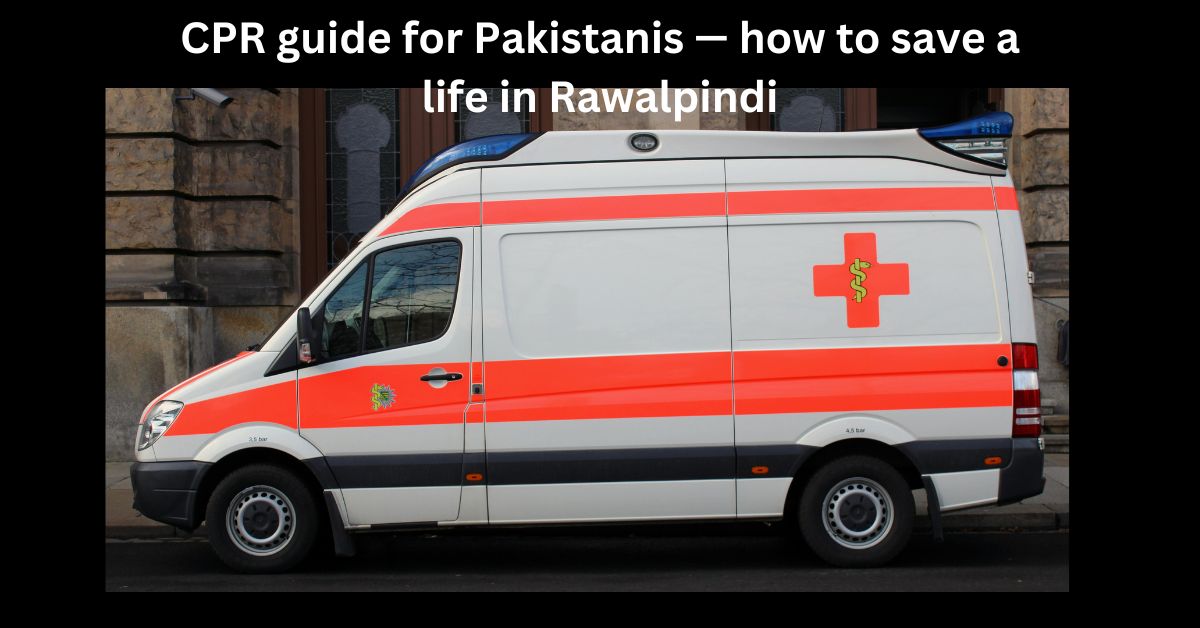
CPR Guide for Pakistanis — How to Save a Life in Rawalpindi
Every year, thousands of Pakistanis suffer cardiac arrests at home, in public spaces, or on the road. In Rawalpindi, the average ambulance response time is 8–14 minutes. But brain damage begins within 4–6 minutes without oxygen. That's where YOU come in. Cardiopulmonary resuscitation (CPR) keeps blood flowing to the brain and heart until professional help arrives. Unfortunately, most bystanders in Pakistan hesitate because they've never been trained or fear doing harm. The truth is: any attempt at CPR is better than none.
This guide is tailored for Pakistanis — using simple Urdu/English terms, local context (like "stay with the victim until the Insaf Ambulance arrives"), and practical tips for Rawalpindi's busy streets and crowded markets. We'll cover hands-only CPR (for untrained rescuers), traditional CPR with breaths, and how to use an AED if available. Plus, we'll explain our ambulance pricing (80–120 PKR/km) and the discount for long-distance transfers (>300 km). By the end, you'll have the confidence to act when seconds matter.
Let's start with the golden rule: Call first, then push hard and fast. Don't wait for someone else — be the hero your community needs.
📖 Table of Contents
- 1. Why CPR Matters in Pakistan
- 2. How to Recognize Cardiac Arrest
- 3. Hands-Only CPR (For Untrained Rescuers)
- 4. Traditional CPR with Rescue Breaths
- 5. CPR Rate & Depth Chart
- 6. Using an AED (Automated External Defibrillator)
- 7. What to Do Until Ambulance Arrives
- 8. Insaf Ambulance: Rapid Response & Pricing
- 9. Frequently Asked Questions
- 10. Related Ambulance Services
🫀 Why CPR Matters in Pakistan – Alarming Statistics
According to the Pakistan Cardiac Society, over 300,000 cardiac arrests occur annually in Pakistan, with survival rates below 3% — compared to 10-12% in countries with widespread CPR training. The main reason? Lack of immediate bystander CPR. In Rawalpindi, most arrests happen at home (70%) or on the road (20%). With Insaf Ambulance's average response time of 9-14 minutes, bystander CPR is the only bridge to survival.
🆘 Step 1: Recognize Cardiac Arrest (DRSABC)
⚠️ Agonal breathing (irregular gasps) is NOT normal breathing — start CPR immediately.
🤲 Step 2: Hands-Only CPR (For Untrained Bystanders)
If you've never taken a CPR course, just do chest compressions. Push hard and fast in the center of the chest. No mouth-to-mouth needed. Follow these steps:
- Place the heel of one hand on the center of the chest (between nipples).
- Place your other hand on top, interlock fingers.
- Position your shoulders directly above your hands.
- Push down at least 2 inches (5 cm) deep.
- Let chest rise completely between compressions.
- Rate: 100-120 compressions per minute (sing "Stayin' Alive" by Bee Gees).
- Continue until ambulance arrives or victim shows signs of life.
🫁 Step 3: Traditional CPR (With Rescue Breaths) – For Trained Rescuers
If you are trained and willing, combine compressions with breaths:
- 30 compressions : 2 breaths cycle.
- Give each breath over 1 second, causing chest to rise.
- For infants and children, use 15:2 if two rescuers.
📊 CPR Rate & Depth Reference Chart
| Age Group | Compression Depth | Rate per minute | Ratio (single rescuer) |
|---|---|---|---|
| Adults & teens | At least 2 inches (5 cm) | 100-120 | 30:2 |
| Children (1 year to puberty) | About 2 inches (5 cm) | 100-120 | 30:2 or 15:2 (2 rescuers) |
| Infants (under 1 year) | 1.5 inches (4 cm) – two fingers | 100-120 | 30:2 (15:2 for 2 rescuers) |
For adults, use two hands. For infants, use two fingers (just below nipple line). Always allow full chest recoil.
⚡ Step 4: Using an AED (Where Available)
Some public places in Rawalpindi (airport, major hospitals, some shopping malls) have AEDs. Turn it on and follow voice prompts. Apply pads to bare chest. Do not use around water or on a moving vehicle. AEDs are safe and will only shock if needed.
🩺 Step 5: What to Do Until Ambulance Arrives
Continue CPR without stopping unless the victim wakes up, starts breathing normally, or you are exhausted. If another bystander arrives, switch every 2 minutes to avoid fatigue. Once the ambulance arrives, step back and let paramedics take over. Provide information: when you started CPR, any changes in condition.
🚑 Insaf Ambulance: Your Partner in Emergencies (Pricing & Fleet)
While you perform CPR, our ambulance races to you. We operate 24/7 across Rawalpindi and Islamabad. Our fleet includes Basic Life Support (BLS), Advanced Life Support (ALS), and ICU ambulances with ventilators and defibrillators — exactly what a post-cardiac arrest patient needs. Our transparent per-kilometer pricing:
| Ambulance Model | Rate (PKR/km) | Equipment Highlights |
|---|---|---|
| Basic Life Support (BLS) | 80 PKR/km | Stretcher, oxygen, first aid, AC |
| Advanced Life Support (ALS) | 100 PKR/km | ECG monitor, defibrillator, paramedic, suction |
| ICU Ambulance (Ventilator) | 120 PKR/km | Portable ventilator, infusion pumps, multi-parameter monitor |
| 🚀 Intercity discount: If distance between cities exceeds 300 km → flat 80 PKR/km for ANY model. Example: Rawalpindi to Karachi (1200 km) – 96,000 PKR instead of 144,000 PKR. | ||
For cardiac emergencies, we recommend requesting an ALS or ICU ambulance to have defibrillation and advanced airway support en route.
❓ Frequently Asked Questions About CPR in Rawalpindi
📚 Related Ambulance Services & Guides
Explore more life-saving resources from Insaf Ambulance:
- 🚑 Non-Emergency Ambulance in Rawalpindi
- 🫁 Ventilator Ambulance in Rawalpindi
- 📞 How to Call an Ambulance – Complete Guide
- 🚑 Ambulance Service in Saddar Rawalpindi
🔗 Main website: Insaf Ambulance Services | 24/7 Contact Page